

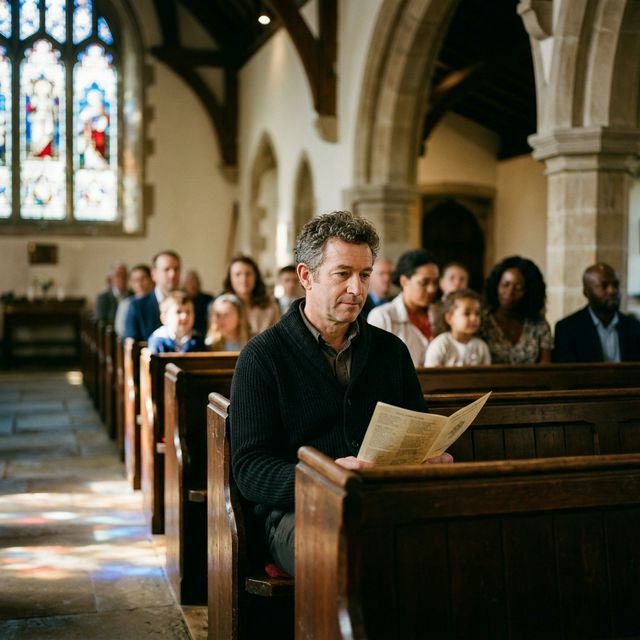
The Moment You Realized This Place Wasn't Built for You
You walk into the church lobby on a Sunday morning and the first thing you see is a giant banner: "Family Fun Night — This Friday!" Below it, a smaller sign: "Couples' Retreat — Sign Up Now!" And next to that, a flyer for the "Mom's Morning Out" group.
You look around for the "People Who Eat Cereal Alone Over the Kitchen Sink at 11 PM" sign-up sheet. It does not exist.
You are single at church. And church, it turns out, was not expecting you.
I don't mean they're rude about it. Nobody pulls you aside and says "Hey, where's your other half?" It's subtler than that. It's the sermon illustrations that always feature a married couple overcoming adversity together. It's the small group options: Young Marrieds, Parenting Through the Chaos, Empty Nesters Rediscovering Joy. It's the way people ask "So, is your family here too?" and when you say "It's just me," their face does that thing. You know the thing. The pitying head tilt. The "Oh, well, good for you for coming anyway!"
Anyway. As if you showed up despite a handicap.
You're Not Imagining It — Church Culture Has a Family-Shaped Blind Spot
Here's the thing: you are absolutely not making this up. Most American churches are structurally designed around families. The programming, the language, the visual branding, the sermon applications — they default to married with kids as the baseline human experience. If you don't fit that template, you're not rejected. You're just… not addressed.
And honestly? That might feel worse than outright rejection. Because rejection is at least an acknowledgment that you exist.
Reddit put it bluntly. One user on r/TrueChristian wrote: "Are you just cooked as a single adult Christian?" — and the thread exploded. Hundreds of people sharing the same gut-punch experience: showing up faithfully, serving on teams, tithing, volunteering — and still feeling like a provisional member of a club they haven't fully qualified for.
Another person described it as being treated like a "fixer-upper project" — where every conversation eventually loops back to "So, are you seeing anyone?" As if the congregation's ultimate goal for you isn't spiritual maturity but marriage.
The Singles Ministry Problem
"But wait," you say. "My church has a Singles Ministry!"
I know. And I need to talk about that.
Look, some singles ministries are wonderful — genuine communities of people doing life together. But let's be honest about what a lot of them actually are: a holding pen. A place to contain the unmarried people until they can be paired off and promoted to the "real" groups.
You can usually tell which kind you've got within the first ten minutes. If the first icebreaker involves the phrase "So what are you looking for?" — congratulations, you're at a church-sponsored speed dating event with a worship set.
The deeper issue is this: when the only dedicated space for single adults is literally defined by their relationship status, it sends a message. It says your identity in this community is "not yet married." You're in the waiting room. The main event is couplehood.
That's not theology. That's just church culture doing what it does — optimizing for its majority demographic and hoping everyone else figures it out.

Your Survival Guide for Being Unpartnered in Pew 7
Okay. You're single. You're at church. The programming wasn't designed with you in mind. Here's how to navigate it without losing your faith or your mind.
1. Stop waiting for the "right" group to appear on the bulletin.
If the only options are Young Marrieds and Moms of Preschoolers, join the one that sounds most interesting to you as a human being — not the one that matches your demographic checkbox. A Bible study on James is a Bible study on James whether you're single, married, or a sentient casserole dish. Some of the best community happens when you ignore the marketing labels.
2. Find a church that talks about all of life, not just married life.
Listen to how the pastor illustrates points. If every example is "my wife and I," "as a father," "our family devotions," that's a clue about who this church thinks its audience is. You want a pastor who sometimes says "I was eating dinner alone" or "my friend and I" or "when I lived by myself." Representation matters. Even from the pulpit.
3. Refuse the "incomplete" narrative.
This is the big one. Church culture sometimes implies — rarely with words, almost always with structure — that singleness is a stage you're passing through on the way to the real thing. Paul — the guy who wrote like half the New Testament — was single. He called it a gift. Not a consolation prize. Not a "season of preparation." A gift. If anyone gives you the pity tilt, you have apostolic permission to politely ignore it.
4. Build your own table.
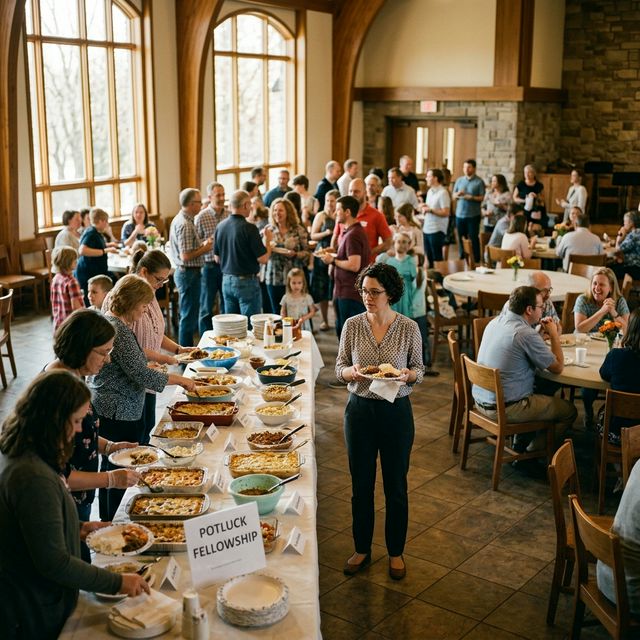
If the church doesn't have a space that fits you, create one. Invite three people to coffee after service. Start a group chat. Host a Sunday lunch. Some of the most meaningful community I've ever experienced was completely unofficial — no church branding, no sign-up genius link, just people who decided to stop waiting for permission to belong.
5. Name it when it matters.
If you're in a church where you feel consistently unseen, it's okay to say that. Talk to a pastor. Send an email. Say: "I love this church, but I notice there's no space for people in my situation. Can we talk about that?" You'd be surprised how many church leaders genuinely haven't thought about it — and are grateful someone brought it up.
The Part Where I Get Honest
Here's what I keep coming back to.
Jesus spent his entire ministry surrounded by people who didn't fit the expected template. Tax collectors, fishermen, women in a culture that sidelined women, children in a world that dismissed children, sick people in communities that blamed them for being sick. He never once said "Come back when you've got your life arranged in the approved configuration."
He said come. Just — come.
And the table he set? It wasn't a couples' table. It wasn't a family table. It was a come-as-you-are table. Twelve dudes who argued about who got to sit where. A woman who crashed the dinner party with expensive perfume and tears. A guy who would literally betray him before dessert.
That was the original church community. Messy, mismatched, and absolutely no one was checking for a plus-one at the door.
If your church makes you feel like you need to be married to be whole, that's not a theology problem. That's a culture problem. And you are not the one who's incomplete.
Your One Thing This Week
Here's the assignment: Show up anyway. But show up for yourself. Not as a half of something. Not as a project to be completed. Not as a person in a waiting room.
Show up as a whole person who is choosing to be there — and if someone gives you the pity tilt, look them dead in the eye and say: "I brought a casserole and I'm not sharing."
Actually, share the casserole. That's how you make friends at church. But you get the point.
You belong at the table. No plus-one required.