

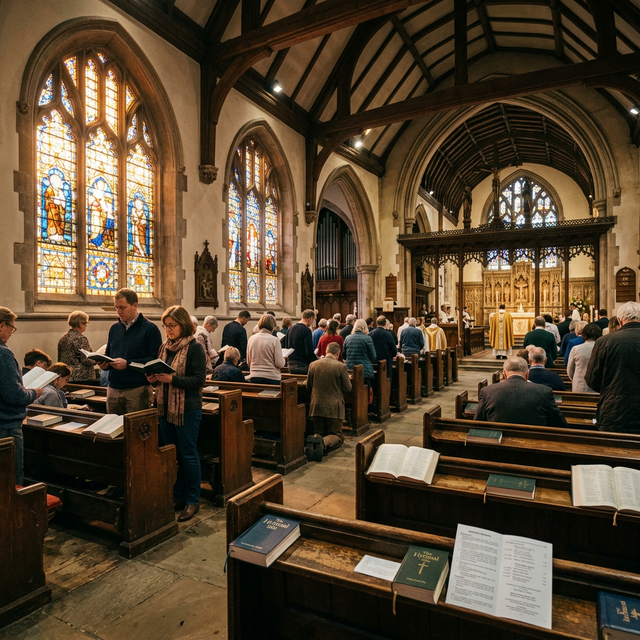
The Moment You Realize Church Has Choreography
You did it. You picked a church. You picked an outfit. You drove there on a Sunday morning like a functioning adult. You even walked through the doors without turning around.
And then, exactly four minutes into the service, everyone around you stood up in perfect unison — like they rehearsed this — and you were still sitting there, holding a bulletin you didn't know how to read, wondering if this was a hymn situation, a prayer situation, or a "we're about to do a group stretch" situation.
Nobody warned you that church was a cardio class.
If you've ever visited a traditional service — Episcopal, Catholic, Lutheran, Orthodox, or any church that uses a liturgy — you've experienced what I call The Liturgical Workout. Stand. Sit. Stand again. Kneel. Stand. Sit. Cross yourself — wait, do I cross myself? Is that mandatory? What hand do I use? Everyone else just did it and I'm still trying to figure out which book I'm supposed to be reading from.
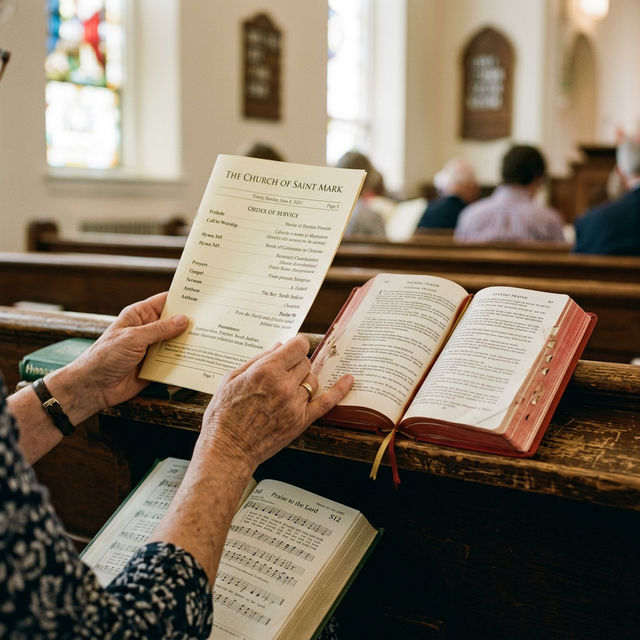
There are three of them, by the way. Three separate books. Sometimes four. Plus a bulletin that might as well be the cheat sheet for an exam you didn't study for.
It's Not Just You — Everyone Was Lost Once
Here's what I need you to hear before we go any further: every single person in that pew was exactly where you are right now at some point. Every one of them. The woman who crosses herself with the precision of a ballet dancer? She spent her first six months following 0.3 seconds behind everyone else. The guy who kneels at exactly the right moment? He absolutely knelt when he was supposed to sit at least twice. Possibly this morning.
Liturgical services have what I think of as a "physical vocabulary" — a set of body movements that correspond to different parts of the service. Standing for the Gospel reading. Kneeling for prayer. Sitting for the sermon. Crossing yourself at the Trinitarian blessing. It's beautiful once you know the language, but when you don't? It feels like Simon Says — except Simon is speaking Latin and everyone else seems fluent.
Here's the good news: nobody is grading your form.
The Three-Book Juggle (And Why You're Not Supposed to Master It on Day One)
Let's talk about the books. Because the books are where most visitors have their first internal meltdown.
In a traditional Episcopal or Lutheran service, you might be working with:
The Hymnal — This is for the songs. It has numbers. Someone will announce the numbers. You flip to the number. So far, so good.
The Book of Common Prayer (or Service Book) — This is the big one. This contains the order of the service, the responses, the prayers. When the priest says something and the entire congregation responds in unison like a well-rehearsed flash mob? They're reading from this book. Page numbers will usually be in the bulletin.
The Bible — Some churches use a separate Bible for the scripture readings. Others have them printed in the bulletin. It depends.
The Bulletin — This is your lifeline. Seriously. It's the cheat sheet. It tells you what's happening, in what order, and which book to open to which page. If you only follow one thing, follow the bulletin.
Here's my actual advice: don't try to use all three books on your first visit. You will drop one. You will lose your page in another. You will accidentally hold the hymnal upside down and read the wrong verse. None of that matters. Just hold the bulletin. Follow along. Watch the person next to you. That's the whole strategy.
The Unofficial Cheat Sheet: Stand, Sit, Kneel
Okay, let's decode the actual choreography. This varies by denomination, but here's the general pattern for most traditional/liturgical services:
STAND — when the procession enters (the part where people walk down the aisle at the beginning), when the Gospel is read (this is a big one — standing for the Gospel is a way of honoring what's being read), and during hymns.
SIT — during the sermon (thank goodness), during the first and second readings (Old Testament and Epistles), and during announcements.
KNEEL — during certain prayers, especially the prayers of the people and the confession. Some churches have padded kneelers built into the pews. If there's a kneeler, that's a hint. If there's no kneeler, nobody expects you to kneel on a hardwood floor. You can stay seated and bow your head. Nobody is going to call you out.
THE CROSS — Some people cross themselves (touch forehead, chest, left shoulder, right shoulder) at certain moments. This is personal. It is not required. You will not be escorted out if you don't do it. Some lifelong members don't cross themselves. You're fine.
Here's the secret weapon: watch the people one row ahead of you. They're your live tutorial. When they stand, you stand. When they sit, you sit. When they kneel, you kneel — or you sit, which is also completely fine. You've just been given a 0.5-second head start on every single movement for the rest of the service.
The Responses: When the Whole Room Speaks and You're Just Mouthing Along
This is the one that really gets people. Because at some point during the service, the priest or pastor will say something — and the entire congregation will respond. In unison. Without hesitation. Like they've been rehearsing this since birth.
"The Lord be with you." (And also with you.)
"Lift up your hearts." (We lift them to the Lord.)
And you're standing there, mouth slightly open, watching 200 people respond like a choir that got its cue, thinking: "Did everyone else get a memo I didn't get?"
Yes. The memo is in the bulletin. Or the prayer book. The responses are printed right there. But here's the thing — you don't have to say them on your first visit. Just listen. Let the words wash over you. The responses have been said for hundreds of years. They'll still be there next Sunday when you come back with a highlighter and a game plan.
Some visitors actually tell me the call-and-response is the part that eventually hooked them. There's something powerful about a whole room speaking truth together. It's not performance — it's participation. But you get to wade in at your own pace.
The Part Nobody Talks About: Why the Structure Actually Helps
Here's where I want to pivot, because I think this is the thing that surprised me most.
When I first visited a liturgical church, I thought the structure was the barrier. All those movements, all those books, all those responses — it felt like there was a wall of tradition between me and God. Like I had to learn the choreography before I could experience worship.
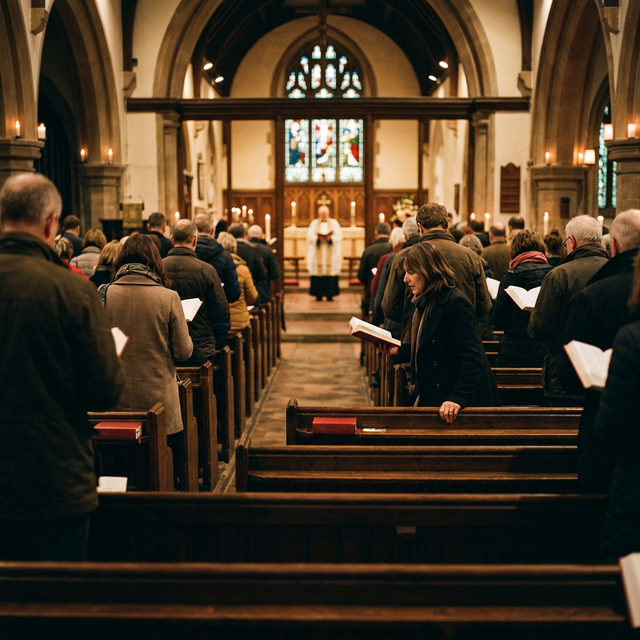
But here's what I've come to believe: the structure isn't the wall. It's a container.
You know how sometimes you're so anxious that your brain can't settle into anything? You can't pray because you don't know what to say. You can't worship because you don't know what to feel. You can't sit still because your thoughts are everywhere.
Liturgy gives you rails. It says: stand here, say this, kneel now. And somehow, in the surrender of not having to figure out what comes next, your mind gets quiet enough to actually be present. The structure does the holding so you can do the feeling.
"Be still, and know that I am God." — Psalm 46:10. Sometimes the sitting, standing, and kneeling is just your body practicing stillness in three different positions until your soul catches up.
Your Assignment for This Week
If you've been curious about a liturgical church — or you visited one and left feeling like you failed the SAT of worship — here's your assignment:
Go back. One more time. But this time, bring only the bulletin. Don't try to juggle three books. Just follow the bulletin's page numbers. Watch the people in front of you. Let them be your guide.
And give yourself permission to just be there — imperfectly, awkwardly, beautifully there.
You don't have to kneel perfectly. You don't have to know every response. You don't have to cross yourself or find the right hymn on time or sit at the exact right moment.
You just have to show up. The liturgy will meet you where you are. It's been doing that for thousands of years. It can handle one more Sunday with you figuring it out.