You Did the Hard Part and It Didn't Matter
Let's talk about what nobody warns you about in the church search. Not the greeter who hugs too hard. Not the offering plate or the loud music or the mystery choreography of sit-stand-kneel. Those are all real, and we've covered them, and they're valid.
But this one is different. This one is quieter. And honestly? It stings worse.
You visited a church and nobody talked to you.
You psyched yourself up for a week. You picked an outfit. You showed up ten minutes early like the anxious planner you are. You found a seat. You made it through the whole service — the music, the sermon, the announcements about the men's breakfast that you will almost certainly not be attending. You even stayed for the little "turn and greet your neighbor" moment, where someone shook your hand, said "good morning," and immediately turned back to the person they actually came with.
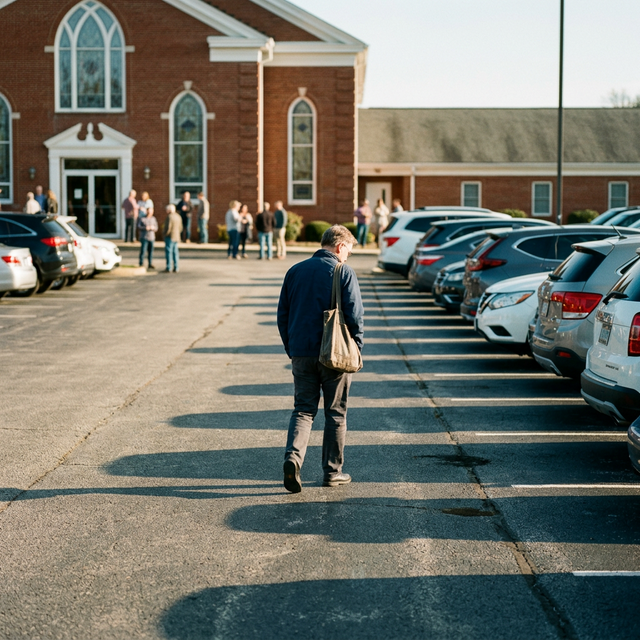
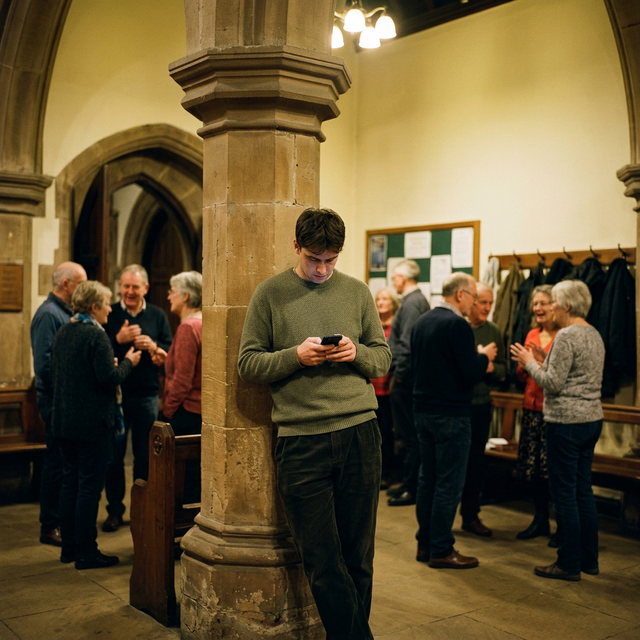
And then the service ended. People stood up. Conversations started — but not with you. Little clusters formed in the aisles like social molecules, bonded to each other and completely impervious to outside elements. You stood there for a minute, maybe two, doing that thing where you check your phone to look busy. And then you walked to your car.
Alone. In the same silence you came in with.
If you're nodding right now, I need you to hear something: this is not a you problem.
Why This Happens (And Why It's Not About You)
Here's the thing that's maddening about this: churches genuinely believe they're welcoming. If you asked anyone in that congregation, "Is your church friendly?" they would say yes without hesitation. And they'd mean it. They're not lying. They're friendly — to each other.
This is what researchers call the "friendly church illusion." The regulars feel warm and connected because they have relationships there. They've been in that building for years. They've done potlucks and prayer chains and that one disastrous church camping trip nobody talks about. Their experience of Sunday morning is rich and relational and comfortable. And they genuinely cannot imagine that someone else in the same room is having the opposite experience.
It's not malice. It's blindness. It's the same reason you don't notice the furniture in your own living room — it's just there. And unfortunately, to a congregation that isn't intentionally looking, you're furniture too.
On Reddit, this comes up constantly. "I went to this church for two months and the only person who spoke to me was the greeter at the door." "I tried three different churches. Same thing every time. I just sat there." "I stopped going and nobody noticed. Not one text. Not one call."
One person wrote: "I thought I was going to find community. Instead I found a room full of people who already have one."
That sentence should haunt every single church leader who reads it.
The Survival Guide: What to Do When You're Invisible
First: Give it three Sundays. I know that sounds brutal when the first one hurt. But here's the uncomfortable truth — one visit is a snapshot, not a portrait. Some churches are genuinely terrible at welcoming visitors. But some churches have people who want to connect with you and just didn't get the chance. It was crowded. They were running late. Their kid had a meltdown in the parking lot. Three visits gives you a pattern, not just a data point.
Second: Try the coffee. If the church has a lobby with coffee — and most of them do, because churches run on two things: Scripture and caffeine — go stand in that area after the service. The lobby is the transition zone. It's where the conversations happen because people are milling around instead of heading straight to their cars. You don't have to start a conversation. Just exist there, visibly, with a cup you didn't even want. Sometimes that's enough for someone to say, "Hey, are you new here?"
Third: Introduce yourself to one person. I know. I know. You're thinking, "I am not the one who should have to do work here." And you're right. In a perfect world, someone would approach you. But this isn't a perfect world — it's a church lobby. And the truth is, most people in that room are just as afraid of talking to a stranger as you are. They're not ignoring you on purpose. They're scared too. If you say, "Hey, I'm new — this is my first time here," you will be shocked at how fast people open up. You just handed them the script they didn't know they needed.
Fourth: Read the room — the actual room. If you visit three times and nobody — not a single person — engages with you beyond a handshake? That's data. That's useful data. It doesn't mean church is bad. It means that church isn't your church. A church that can't see you standing right in front of them isn't ready for you yet. That's not rejection. That's redirection.

The Thing Nobody Says Out Loud
Can I be honest for a second? The reason this particular pain point hits so hard isn't just social awkwardness. It's that going to church was supposed to be the answer. You were lonely, or searching, or hurting, or curious, and somewhere in the back of your mind you thought: "Church is where people are supposed to care about you. Church is community. Church is where you belong."
And then you went. And the room was full of belonging — just not for you. And that gap between what you expected and what you got? That's not just disappointment. That feels like proof. Proof that you don't fit. Proof that even the place designed for welcome doesn't have room for you.
That is a lie. And I need you to hear me say that with my whole chest.
There's a moment in Matthew where Jesus is talking about the shepherd who leaves ninety-nine sheep to go find the one that wandered off. We usually read that as a story about people who've left the faith. But I think it's also about people who showed up and got lost in the crowd. The shepherd doesn't say, "Well, they're in the general area of the flock, so they're fine." He goes looking. He notices the one who's missing.
God is not a church lobby. He doesn't cluster up with the people He already knows and leave you standing by the coffee station pretending to read a bulletin. He comes to find you. He walks past the ninety-nine to get to you. That's not a metaphor. That's a promise.
Your invisibility in a room full of people does not reflect your visibility to God. Not even close.
Your One Thing This Week
If you visited a church and felt invisible — and you're wondering whether to try again or just stay home where at least the silence is on your terms — here's your assignment: try one more time, at a different church, and arrive five minutes late.
I know that sounds backwards. But here's why: when you arrive after the service starts, you skip the awkward lobby shuffle entirely. You slip in, you sit down, and you let the service be about what it's supposed to be about. Then, when the service ends, you have a natural on-ramp: "I just started visiting — what's this church like?"
And if that church is also silent? If nobody talks to you there either? Then you've eliminated two options and you're closer to the one that's going to feel like home. The search isn't failing. It's working.
You are not invisible. You are not unwanted. You are someone who had the courage to walk into a room full of strangers and hope for something real. That's not weakness. That's one of the bravest things a person can do on a Sunday morning.
Keep going. The right room is out there. And in that room, someone is going to see you — really see you — and you're going to know the difference.