

The Moment Your Stomach Drops
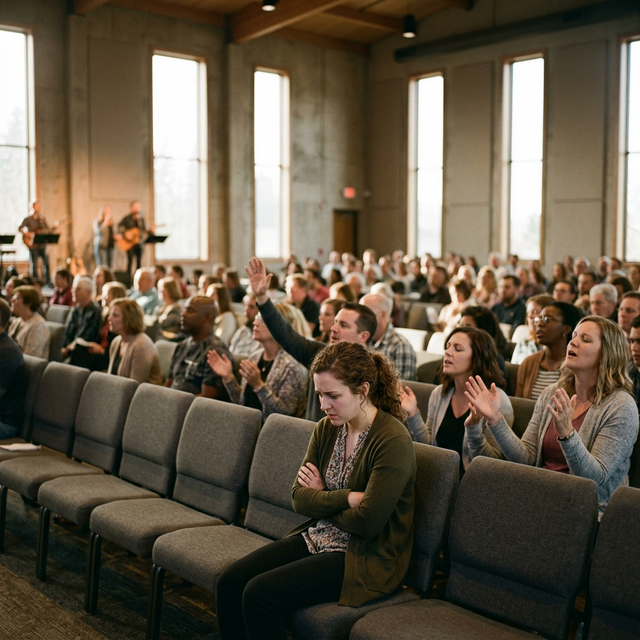
You did it. You actually did it. You got up early on a Sunday, put on something that felt "church enough" (but not too church), drove to a building you've never been to, found parking without a meltdown, and slipped into a seat near the back where you could observe without being observed.
You were doing so well.
The worship songs were fine — you swayed a little, kept your hands at your sides like a reasonable human. The pastor seemed nice. The coffee was surprisingly decent. You were starting to think, Hey, I could maybe do this.
And then.
The pastor smiles that smile — the one that says something terrible is about to happen — leans into the mic, and says:
"If you're visiting with us for the first time today, would you raise your hand so we can welcome you?"
And just like that, every ounce of anonymity you carefully constructed over the past 45 minutes evaporates. Your fight-or-flight kicks in. Your hand does not move. Your brain screams. You are a deer in headlights, except the headlights are 200 people turning to look for the new person who hasn't raised their hand yet.
If you've ever been ambushed by the Visitor Spotlight, this one's for you.
Why Churches Do This (And Why It Backfires)
Here's the thing: the intention behind "raise your hand if you're new" is genuinely good. Churches want visitors to feel seen. They want you to know you're welcome. The greeter team has been praying for new faces all week. They are thrilled you're here.
The problem? They're thrilled in a way that makes introverts want to tunnel through the floor.
There's a massive disconnect between what the church thinks they're communicating ("We're so glad you're here!") and what the visitor actually hears ("We have identified you as an outsider. Please confirm."). It's like being at a party where the host grabs the microphone and says, "Everyone, THIS PERSON doesn't know anyone here. Let's all stare at them."
Some churches take it even further. They don't just ask you to raise your hand. They ask you to stand up. Some ask you to introduce yourself. Some — and I wish I were making this up — ask the entire congregation to come shake your hand while you stand there, frozen, accepting handshake after handshake like you're running for office in a county you've never been to.
One person on Reddit described it perfectly: "I spent the entire week working up the courage to visit, and within 10 minutes they made me the center of attention. I never went back."
The Survival Guide: What to Actually Do
Alright, let's get practical. Because this moment is going to happen at some churches, and you deserve a game plan that doesn't involve army-crawling to the exit.
Option 1: Don't raise your hand. This is completely, 100% acceptable. I need you to hear this: you are not obligated to identify yourself. No one is taking attendance. There is no church police. If you don't raise your hand, exactly nothing happens. The moment passes. The pastor moves on. Life continues. You are not being rude. You're being a human who showed up and that's already huge.
Option 2: The subtle wave. If you feel like you want to be polite but not become the center of a welcoming stampede, try the micro-wave. A tiny hand raise — like you're asking a waiter for the check, not flagging down a rescue helicopter. Quick up, quick down. Smile. Done.
Option 3: Scout ahead. Before you visit, check the church's website or social media. Look for their "What to Expect" or "I'm New" page. Some churches are starting to specifically mention that they won't put you on the spot — and honestly? That's a green flag the size of a football field. If a church proactively says "We won't make you stand up or single you out," they understand something important about hospitality.
Option 4: The strategic arrival. Here's a pro tip nobody tells you: some churches do the visitor callout in the first 15 minutes while making announcements. If you arrive right when the service starts (or even a few minutes after), you might skip the announcement section entirely and waltz in during worship when everyone's eyes are closed anyway.
Option 5: Bring a buddy. Everything is less terrifying when someone else is terrified with you. If a friend has been nudging you to visit their church, take them up on it. Let them be the one who raises their hand and says, "I brought my friend!" You just sit there and wave like royalty.
What Good Churches Are Starting to Get Right
Here's the encouraging news: a lot of churches are figuring this out. They're realizing that putting a spotlight on visitors in a room full of strangers is the hospitality equivalent of a pop quiz — it tests the person instead of serving them.
The best churches I've visited do something different. Instead of making you perform your newness, they build systems that let you come as you are:
Connection cards in the seat back. Fill one out if you want. Don't if you don't. No public declaration required.
A welcome table in the lobby. Staffed by actual humans who introduce themselves without ambushing you. You approach them, on your terms.
A "no spotlight" policy. One church I visited had it written right on their website: "We will never ask you to stand, raise your hand, or identify yourself. Just come as you are." I wanted to frame it.
The after-service hang. Instead of putting you on the spot during the service, they create casual space afterward — coffee, snacks, a few friendly people available to answer questions. No pressure. No performance.
If a church does this? That's a church that understands the difference between wanting you to feel welcome and making you feel welcome. Those are two very different things.
The Part Nobody Talks About
Here's what I keep coming back to: the fact that this moment scares people away from church — sometimes permanently — should break our hearts a little.
Because what's actually happening in that moment isn't about a hand raise. It's about vulnerability. You showed up to a place full of strangers because something in you is searching — for community, for peace, for answers, for God, for something. And that kind of searching is already one of the bravest things a person can do.
There's a verse in Matthew where Jesus says, "Come to me, all you who are weary and burdened, and I will give you rest." He didn't say, "Come to me, but first raise your hand so everyone can see you coming." He just said come. The invitation was the whole thing.
I think the best churches are the ones that sound like that invitation — where showing up IS the whole thing, and nobody needs you to perform your arrival.
Your One Thing This Week
If you're in the middle of a church search, here's your assignment: visit one church website and look for their "What to Expect" page. Read it carefully. Does it mention visitor recognition? Does it tell you what will happen when you walk in? Does it feel like they're trying to prepare you or recruit you?
A church that takes the time to tell you what to expect is a church that's thinking about you before you even show up. And that's the kind of welcome that doesn't need a spotlight.
You showed up. That's not small. That's the whole thing.