

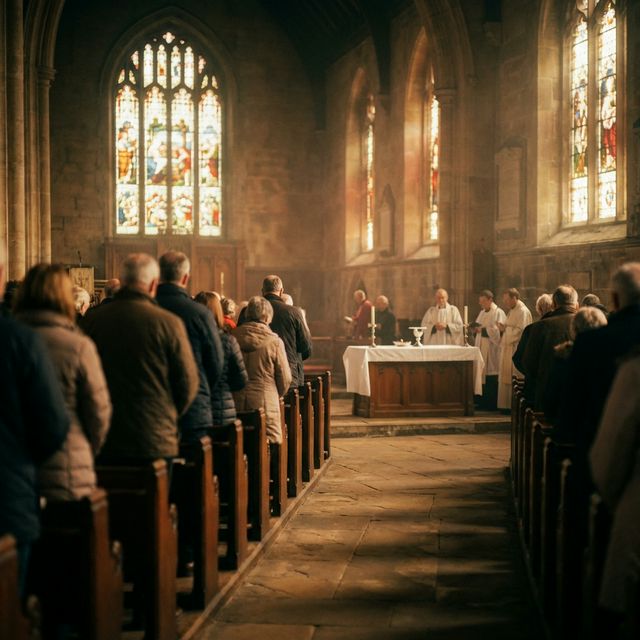
The Moment Nobody Warns You About
You've survived the parking lot. You navigated the greeter. You found a seat in the back third, on the aisle, just like I told you to. You're feeling almost — almost — like you've got this.
And then the pastor says something like: "And now let us come to the Lord's Table."
And your brain goes: the what now.
People start standing up. Or not standing up. Someone is passing a tray. Or people are walking to the front. There's bread — or is it a cracker? And a tiny cup of something. Grape juice? Wine? Both? One woman just dipped the bread INTO the cup and now you're spiraling because you didn't know that was an option and also, is that sanitary?
Welcome to communion. The most sacred, beautiful, and — for visitors — absolutely terrifying 90 seconds of any church service.
I once sat in a pew watching the communion tray come my direction like it was a ticking bomb on a conveyor belt. I took the cracker. I took the juice. I ate the cracker. And then I didn't know if I was supposed to drink the juice at the same time as everyone else or right away, so I just held it and waited and then panicked and drank it during the prayer when everyone's eyes were closed. Stealth communion. Very reverent.
Why This Is So Confusing
Here's the brutal truth: communion is handled differently in almost every Christian tradition, and nobody posts the rules at the door.
Some churches welcome everyone. Some churches welcome only baptized Christians. Some churches welcome only members of their specific denomination. Some churches have a whole process you need to complete before you're "eligible." And the worst part? They rarely explain which policy they follow before the moment arrives.
If you've been browsing Reddit threads about this (and I know some of you have, because I have too), you've seen the panic: "I'm visiting a Catholic church — am I allowed to take communion?" and "I accidentally took communion at a church where I wasn't supposed to and now I'm mortified."
So let's fix that. Consider this your cheat sheet — the one every church should hand out but almost none of them do.
The Denomination Decoder
Every church falls somewhere on a spectrum from "everyone is welcome at the table" to "please fill out this form and come back in six months." Here's the general breakdown:
Open Table (Come On Up): Most non-denominational, many Baptist, most Methodist, Episcopal, many Lutheran (ELCA), many Presbyterian, and most Evangelical churches practice what's called "open communion." If you believe in Jesus, you're welcome to participate. Some say "all who love the Lord" or "all who are seeking." When in doubt at these churches: go for it.
Semi-Open (Baptized Christians Welcome): Some churches welcome any baptized Christian, regardless of denomination. You'll hear phrases like "all baptized Christians are welcome at this table." If that's you, you're good. If you haven't been baptized, it's totally fine to stay seated.
Closed Table (Members/Specific Tradition Only): Catholic and Orthodox churches reserve communion for their own members who are in "good standing" (which has specific theological meaning). Lutheran Church-Missouri Synod (LCMS) also practices closed communion. This is not a rejection of you — it's about their theology of what communion is. More on that in a second.
The Three Escape Routes
If you're visiting and you're not sure whether you should participate, here are your three perfectly acceptable options. Use whichever one your anxiety prefers:
Option 1: Stay Seated. This is the simplest and most common visitor move. Nobody is watching you. I promise. Everyone else has their eyes closed or is thinking about lunch. Sit there, breathe, maybe use the moment to just... be still. There is nothing wrong with observing. You are not failing a test.
Option 2: Go Up, with Arms Crossed. In many traditions (especially Catholic, Episcopal, Anglican, and some Lutheran churches), you can walk up to the altar with your arms crossed over your chest. This signals: "I'm not receiving communion, but I'd like a blessing." The priest or pastor will typically pray over you or place a hand on your head. It's actually a really beautiful moment — you're saying "I'm here, I'm just not ready for this part yet," and the church is saying "we see you and we're glad you came."
Option 3: Take It. If the church has announced open communion and you feel moved to participate — do it. You don't need to have a theology degree. You don't need to have all your questions answered. If you believe and you feel invited, that's enough. Paul didn't say "let the people who have read enough commentaries eat." He just said do this.
The Physical Logistics (Because This Is Where It Gets Weird)
Even if you've decided to participate, the mechanics can trip you up. Because churches cannot seem to agree on a delivery method.
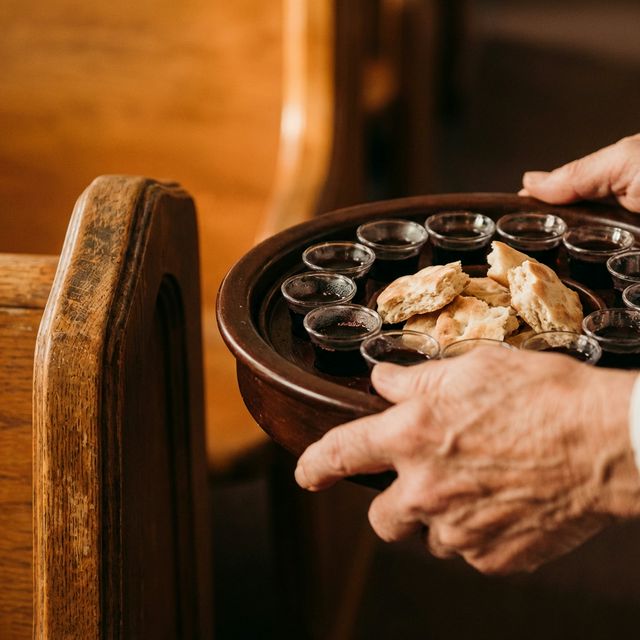
The Tray Pass: Some churches pass a tray down the row with little cups of juice (or wine) and either bread cubes or those oyster-cracker-looking wafers. Take one of each. Wait for the pastor to say "eat" and "drink" — or eat immediately if people around you are doing that. Copy the person next to you. This is not the moment for originality.
The Walk-Up: Some churches have you walk to the front and receive the elements from a pastor. You might get a piece of bread torn from a loaf, or a wafer placed in your hand (cup your hands, palms up). Then move down the line to the cup — either take a small individual cup, or (and this is where it gets advanced) dip the bread into the common cup. That's called intinction. Yes, it's a real word. No, I did not make it up.
The Kneeling Rail: In some traditional churches (Catholic, Episcopal, Anglican), you walk up and kneel at a rail. You might receive a wafer on your tongue or in your hands. The person with the cup might say "the blood of Christ" and you say "amen" and take a sip. If the shared cup situation is not your thing, you can skip the cup. Nobody is keeping a scorecard.
Pro tip: If the person next to you looks like a regular, watch them first. The 0.5-second delay between their move and yours is invisible. I've been using the "observe then copy" strategy for years and nobody has ever called me out.
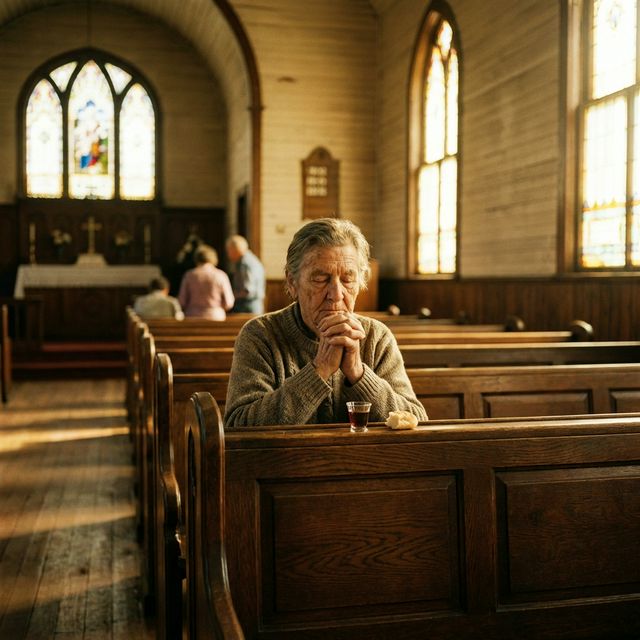
Things Nobody Will Judge You For (Even Though You Think They Will)
Let me just run through the list of things visitors stress about that literally no regular church attendee is thinking about:
✅ Not taking communion. Completely normal. Lots of members skip it some weeks too.
✅ Taking communion when you weren't sure you should. You're not going to get escorted out. Grace is kind of the whole point.
✅ Holding the cup wrong. There is no wrong way.
✅ Dropping the bread. It happens. Pick it up. The five-second rule applies to sacred rituals, apparently.
✅ Not knowing the words. Most responses are said by the congregation together. If people around you are mumbling "the body of Christ, broken for you," you can mumble along or stay quiet.
✅ Crying. Communion is emotional. It's designed to be. If you tear up, you're doing it right.
What Communion Is Actually About
Since we've been doing survival mode this whole time, let me switch gears for a second.
All the logistics — the crackers, the cups, the kneeling, the arm-crossing — that's all just the container. What's inside is something much simpler.
Communion is a meal. A remembering meal. Jesus, on the night before He died, gathered with His friends — people who would betray Him, deny Him, and scatter — and He broke bread and said, "This is my body, given for you. Do this in remembrance of me."
He didn't say "do this once you've figured it all out." He didn't say "do this once you're worthy." He broke bread with people who were confused, afraid, and about to fail spectacularly.
Sound familiar?
The table isn't for people who have arrived. It's for people who are still on the way. And the fact that you're reading a whole internet article about whether you're allowed to eat a cracker at church tells me something important about you: you care. About doing it right. About being respectful. About being honest about where you are.
That matters more than any denomination's policy on who gets to hold the cup.
Your Assignment This Week
Before you visit a church this weekend, do this one thing:
Check their website for a "What to Expect" or "I'm New" page and look for their communion policy. If they mention communion, note what they say: open table? All baptized believers? Members only? If they don't mention it at all, email the church or DM them on Instagram. Ask: "I'm visiting for the first time. What should I know about communion?"
A church that answers that question warmly is telling you something. A church that makes you feel dumb for asking is also telling you something.
And if you show up on Sunday and the tray starts coming your way before you've done any research? Stay seated. Take a breath. Watch the room. You didn't fail the assignment.
The bread will be there next week. And the week after. And that table isn't going anywhere — it's been set for two thousand years, and it can wait for you.