

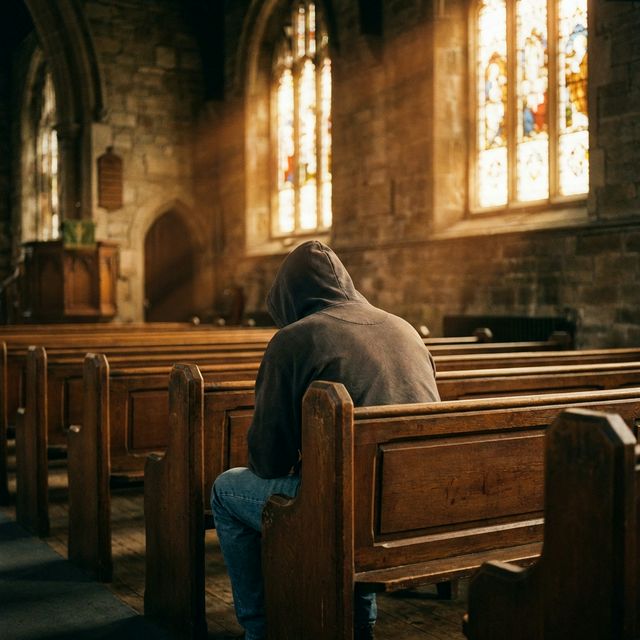
The Parking Lot Is the Hardest Part
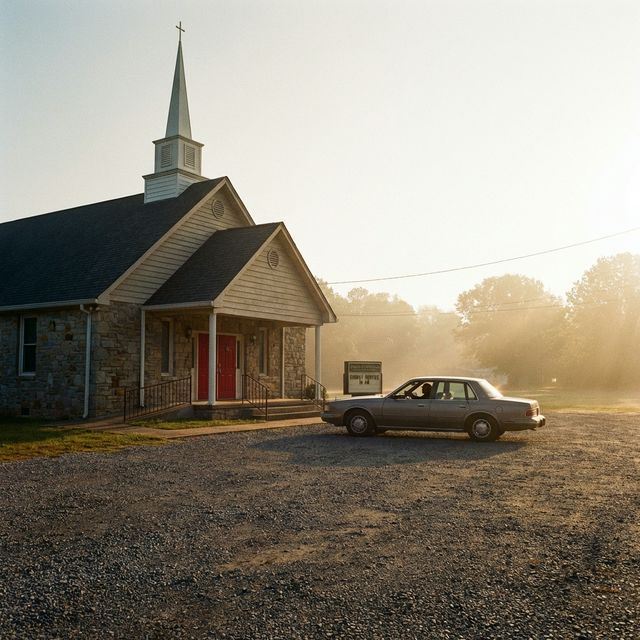
Let me paint you a picture. It's Sunday morning. You've done the research. You've found a church with a website that didn't give you early-2000s GeoCities vibes. You drove there. You found a parking spot. And now you're sitting in your car, engine off, staring at the front door like it's a portal to another dimension.
Your hands are doing that thing where they grip the steering wheel even though you're in park. You're watching families walk in like they have a secret password. A guy in a polo shirt is standing by the door and he looks enthusiastic. Your brain is calculating the exact angle at which you could reverse out of the parking lot without anyone noticing.
I have been this person. I have been this person so many times that I once accidentally made eye contact with the parking lot greeter and then pretended to take a very important phone call. For eleven minutes. In silence.
If you're reading this, you probably know the feeling. And I want you to know something before we go any further: the fact that you showed up at all — even if you never left the car — is not nothing.
Why Your Brain Treats Church Like a Threat
Here's what nobody talks about: walking into a church you've never been to activates the same part of your brain as walking into a party where you don't know anyone, except this party might ask you to hold hands with a stranger, sing songs you don't know the words to, and then evaluate your eternal soul.
That's a lot.
And it's gotten worse. If you're reading this in 2026, you're operating in a world where most of us have spent years losing our "unscripted social gathering" muscles. The pandemic didn't just change how we work — it changed how we show up in rooms full of strangers. We lost the reps. And church is basically the social anxiety Olympics.
So let's break down the actual fears, because naming them is the first step to disarming them.
The Greeter Gauntlet
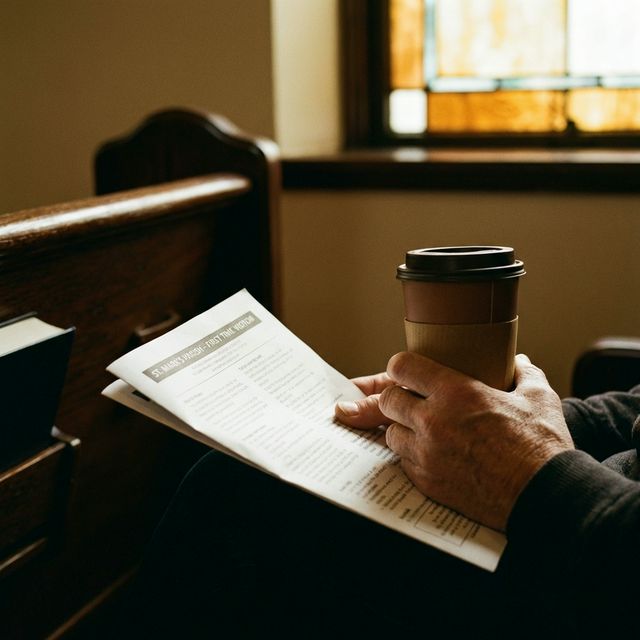
Every church has a front-door person. Sometimes they're holding a bulletin (that's the little folded paper with the schedule — churches call it a "bulletin" because "program" was apparently too casual and "pamphlet" was already taken by dentists). Sometimes they're holding a coffee. Sometimes they're holding your hand before you've consented to physical contact.
Survival tip: The greeter is usually the friendliest 2% of the congregation. They are not a representative sample. The rest of the church is just as nervous about talking to a stranger as you are. Accept the bulletin, say "first time here," and keep moving. You do not need to explain your entire spiritual journey to someone named Gary at 9:47 AM.
The Where-Do-I-Sit Crisis
This is the one nobody warns you about. You walk into the sanctuary (fancy word for "the big room with the chairs") and suddenly every seat feels like a trap. Too close to the front? You'll be visible. Too far in the middle? You're boxed in. The back row? That's where the pros sit — the ushers, the nursing moms, the people who've been attending for 20 years and know exactly when to slip out before the post-service small talk.
Survival tip: Aim for the back third, on an aisle. This gives you an exit strategy and visibility of the room without being in anyone's spotlight. If someone says "oh, you don't want to sit back here!" — yes, you do.
The Greeting Time
Ah, yes. The moment that church leadership designed to foster community and that introverts have been having nightmares about since 1987. Somewhere around the 20-minute mark, someone on stage will say: "Turn to your neighbor and say good morning!"
Your neighbor will attempt a handshake, a hug, or some hybrid physical greeting that hasn't been formally classified yet. They will ask your name. They will forget it immediately. You will forget theirs. This is fine. This is normal. This is universal.
Survival tip: Have a one-liner ready. "Hey, I'm [name], first time here" is more than enough. If someone launches into a full conversation, it's okay to smile, nod, and gesture vaguely toward the stage as if the service is about to resume. Even if it isn't.
The Music Problem
Here's where it gets sensory. Some churches have a volume level that can only be described as "rock concert meets prayer meeting." You don't know the songs. The lyrics on the screen change before you can read them. Everyone around you has their eyes closed and their hands up and you're standing there like a deer in headlights wondering if you accidentally walked into the wrong building.
Other churches are dead silent except for a pipe organ and a hymnal, and you're flipping through 800 pages trying to find hymn #347 while everyone else found it before the organist hit the first note.
Survival tip: You are not being graded on your singing. You are not expected to know the songs. Standing there, listening, even just breathing — that counts. If the volume is genuinely painful, there is no shame in stepping out to the lobby (narthex, if the church is fancy about it). That's what lobbies are for.
The Follow-Up Fear
You survived the visit. You made it home. You exhaled for the first time in 90 minutes. And then it starts: the text from an unknown number. The email that says "We noticed you visited!" The envelope in your actual mailbox three days later. Some churches follow up like they're tracking a FedEx package.
Survival tip: On the visitor card (if you fill one out — and you don't have to), you can write your email only. You can check "do not contact" if that's an option. Or you can leave it blank entirely and visit again when you're ready. A church that respects your pace is a church worth returning to. One that sends three texts before Tuesday is giving you data — use it.
The Part Nobody Tells You
Here's what I wish someone had told me when I was frozen in my Honda Civic at 9:32 AM, gripping a lukewarm coffee and questioning every decision that led me to that parking lot:
You don't have to do this perfectly.
You can show up late. You can leave early. You can sit in the back and not sing a single note. You can cry during a song you don't know the words to and blame it on allergies. You can visit three churches in three weeks and like none of them. You can take a month off and try again.
There's a verse in Hebrews — and I promise I'm not going to get preachy about it, but — it says, "Let us not give up meeting together, as some are in the habit of doing, but let us encourage one another." And I used to read that as a guilt trip. Like God was saying, "You'd better show up." But the more I sit with it, the more I think He's saying, "Don't miss out on this."
It's not a command. It's an invitation. And invitations don't expire when you show up five minutes late in jeans and a hoodie.
Your Assignment This Week
Don't visit a church. Not yet. Instead, do this:
Find one church website. Just one. Look for their "I'm New" page or "Plan Your Visit" page. If they have one, read it. Does it feel warm? Does it answer your actual questions (parking, dress code, what to expect)? Or does it feel like a terms-of-service agreement?
If it makes you feel seen — even a little bit — put it on the list. That's the whole assignment.
The parking lot will be there when you're ready. And when you finally do walk through those doors, trembling hands and all, you might just find that the hardest part was already behind you.
You already showed up. The rest is just details.