

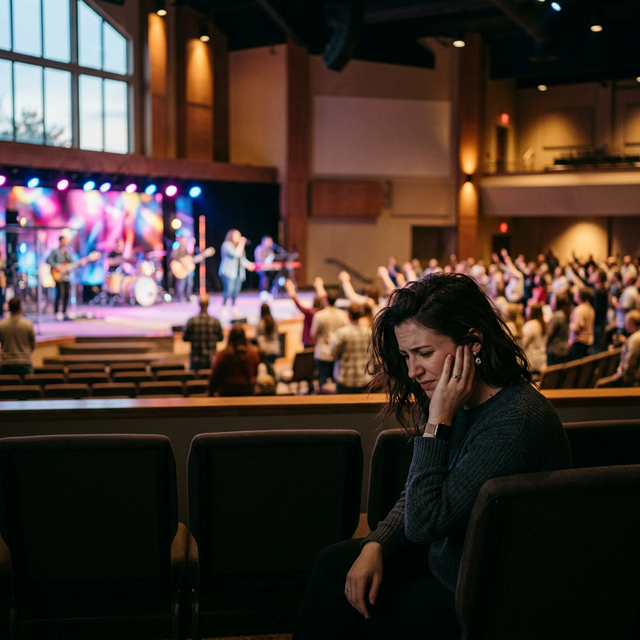
The Moment You Realized You Were at a Concert, Not a Church Service
You walked into the lobby and everything was fine. Someone handed you a bulletin. Another person smiled. You found a seat — not too close, not too far — and you thought, okay, I can do this.
Then the worship band kicked in.
And the bass hit your chest like a defibrillator.
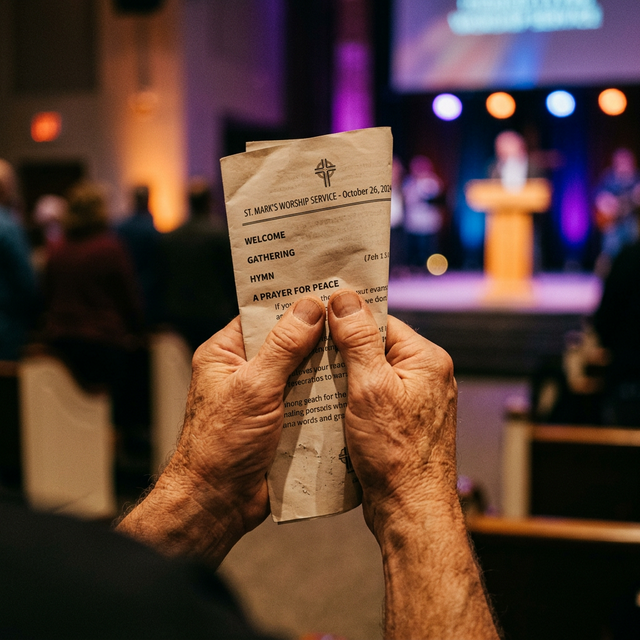
Your teeth were vibrating. The lyrics on the screen were shaking — or maybe that was your retinas. The woman next to you was singing with her eyes closed, hands raised, completely at peace, while you were gripping your bulletin like it was a flotation device and wondering if your eardrums had a return policy.
You wanted to say something. You wanted to tap someone on the shoulder and ask, "Is this... normal?" But everyone around you looked like they were having a transcendent spiritual experience, and you were the only one wincing, so you did what any reasonable person does: you sat there, smiled through the pain, and quietly Googled "is church concert volume safe for ears" on your phone.
If this is you, welcome. Pull up a chair — far from the speakers. Let's talk about it.
You're Not the Only One Thinking It
Here's a secret the worship pastor doesn't want you to know: a LOT of people think the music is too loud. They just won't say it. The complaint sounds petty. It sounds like something your grandma would say. And nobody wants to be the person who shows up at a new church and immediately starts critiquing the production values.
But go spend five minutes on Reddit and you'll find dozens of threads from visitors — young visitors, not just the over-60 crowd — asking the same question: "Is it normal for church music to be this loud?"
The answer, annoyingly, is: it depends on the church. Some congregations run their worship at 85-90 decibels. Others crank it to 98+. For reference, a movie theater runs at about 85 dB. An ambulance siren is 120. Some megachurch worship sets are closer to the siren than the movie.
And here's the thing nobody tells you: prolonged exposure above 85 dB can actually damage your hearing. This isn't a matter of preference. It's physics. And if you leave a church visit with your ears ringing, that's not the Holy Spirit — that's tinnitus.
Why Churches Do This (It's Not Malicious)
Before we go full curmudgeon, there IS a logic behind the volume. Churches discovered — correctly — that when the music is louder, people sing more freely. If you can't hear your own voice over the band, you're less self-conscious. You're more likely to belt out that chorus instead of mumbling it into your coffee.
The idea is to create an atmosphere where participation feels safe. Ironically, for a lot of regular members, the volume IS the comfort zone. It's the wall of sound that lets them worship without feeling exposed.
But here's where it gets tricky: what feels like freedom to a regular can feel like an assault to a visitor. Especially if you're already anxious about being in a new place, already hypersensitive to stimuli, already running a mental checklist of "sit, stand, sit, clap? don't clap? hands up? hands definitely not up." Adding concert-volume bass drops to that experience is like giving someone a fire hose when they asked for a glass of water.
The Visitor's Survival Kit for Loud Worship
Let's get practical. Here's your game plan for the next time the worship set feels less like a hymn and more like a Hillsong UNITED stadium tour:
1. Bring earplugs. Seriously. This isn't weird. Musicians wear them on stage. Sound engineers wear them in the booth. You're allowed to protect your hearing in a house of worship. Carry a discreet pair of foam earplugs or invest in musician's earplugs that reduce volume without distorting the sound. Nobody will notice. And if they do, they'll probably ask where you got them.
2. Sit farther back. Sound is loudest near the front and near the speakers (which are often mounted on the sides of the stage). The back rows and center seats are usually the sweet spots for a more manageable volume. Bonus: you also get a clear exit if you need one.
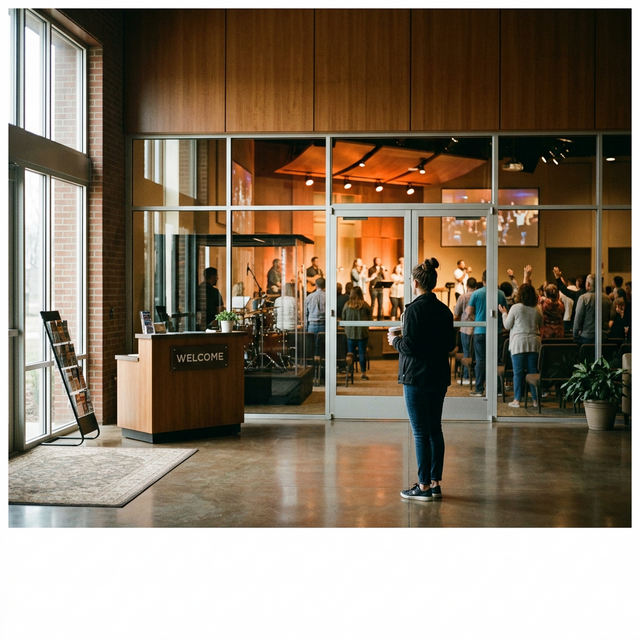
3. Step out — and don't feel guilty about it. Most churches have a lobby, a foyer, or that room with the big window where they put parents with fussy babies. You're allowed to be in that room too. Nobody is keeping attendance on who stayed in the sanctuary for all four worship songs. Take a breather. Get coffee. Come back for the sermon.
4. Check the church website first. Some churches are getting smart about this. They'll list their worship style right on the "What to Expect" page. Look for phrases like "contemporary worship" (probably loud), "acoustic worship" (probably mellower), or "liturgical" (hymnals, organ, and usually at a volume your grandmother would approve of). A few even post videos of their services — watch one with the volume on and your answer will be clear.
5. Ask someone. After the service, find someone who looks approachable — not the worship leader, they're emotionally invested — and ask, "Is the music always at this volume?" You'll get an honest answer. And if the honest answer is "oh yeah, we love it loud," that's useful information for your church search calculus.
What If You Love Everything About This Church... Except the Volume?
This is the real question, isn't it? You found a church where the sermon hits, the people are kind, the coffee is actual good coffee and not that church-basement percolator situation — but every Sunday morning your nervous system goes into fight-or-flight during the first song.
Is that a dealbreaker?
Here's what I think: if a church checks every other box and the only issue is volume, it's worth having a conversation. Email the worship pastor. Mention it to a greeter. Some churches have started offering "sensory-friendly" services or quieter worship options and they don't advertise them well. Others have designated seating areas with reduced sound. You won't know unless you ask.
And if you ask and the response is dismissive — "that's just how we worship here" with no willingness to consider accessibility — well, that tells you something about the culture. And that is more important data than the decibel reading.
The Deeper Thing Nobody's Saying
Here's where I'll get a little honest: I think the volume issue points to something bigger than speaker placement and sound boards.
There's a verse in Psalm 46 that says, "Be still, and know that I am God." And I wonder sometimes if we've built worship environments where stillness is almost impossible. Where every gap is filled with sound, every silence is avoided, every moment is produced.
That's not a criticism of contemporary worship. Some of the most moving worship experiences of my life involved a full band at full volume. But I've also met God in silence. In the quiet of an empty chapel. In the three seconds between songs when nobody was performing anything and the room just... breathed.
If you're someone who needs a little more quiet to connect with God, that's not a weakness. That's not being difficult. The Bible is full of people who met God in the whisper, not the earthquake (looking at you, Elijah). Your way of connecting with God is just as valid as the person next to you with their hands raised and their eyes closed, completely unbothered by the 95 decibels.
God doesn't need a subwoofer to get your attention. He already has it. That's why you showed up.
Your One Assignment This Week
If you're church shopping and volume is a factor — and it's okay if it is — here's what I want you to do: watch one online service from a church on your list. Turn the volume up to a comfortable level and pay attention. Does the sermon connect? Do the people seem genuine? Can you picture yourself there?
If yes, go visit. Bring earplugs. Sit in the back. And give yourself permission to step out if the bass hits too hard.
You're not being difficult. You're being intentional. And that's exactly how a good church search should feel.