

The Tray Is Moving and So Is Your Heart Rate
You're 40 minutes into your first visit at a new church. You've survived the greeter. You found a seat. You even sang along to a chorus you didn't know (mumbled, mostly, but you were in the vicinity of the melody). Things are going well.
And then someone on stage says: "At this time, we're going to receive our tithes and offerings."
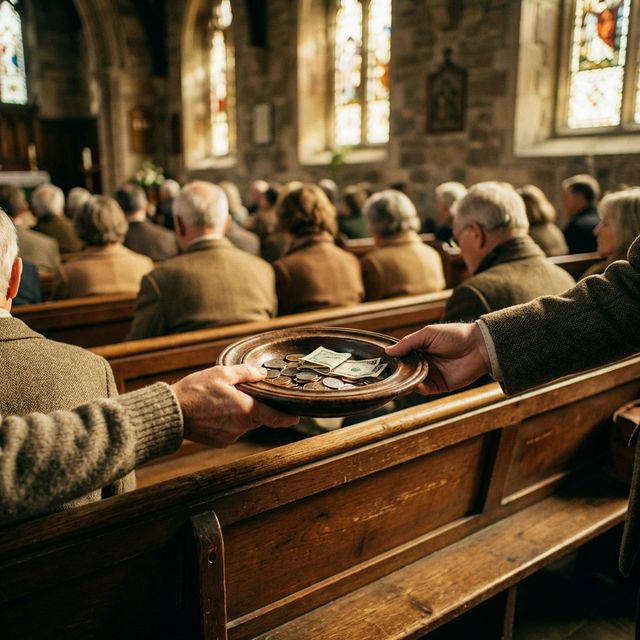
And a wooden plate — or a velvet bag, or a brass bowl, or in one memorable case, a wicker basket that looked like it belonged at a farmer's market — starts making its way down the row. Toward you. With purpose.
Your brain immediately runs a cost-benefit analysis: Do I have cash? I don't carry cash. Is there an amount that's too little? What if I put in a five and the guy next to me put in a fifty? Can I just... pass it? Will people notice? Will God notice? Is this a test?
I have been this person. I once held an offering plate for so long trying to decide what to do that the woman next to me gently took it from my hands like she was disarming a nervous toddler. She smiled. I died inside. We don't talk about it.
Why This Feels So Loaded
Let's be honest about what's happening here. You walked into a building you've never been in, surrounded by people you don't know, and now someone is asking you for money. In almost any other context, that would feel like a scam.
And if you've spent any time on Reddit (which, let's be real, is where half of you are doing your church research), you've seen the horror stories: pastors who guilt-trip people into giving, churches that track your donations, envelopes with your name on them so leadership knows exactly who gave what. One person described their church's approach as having a "cover charge."
So yeah. The anxiety makes sense. And I want to tell you something important before we go any further:
You are not required to put a single dollar in that plate. Not as a visitor. Not ever.
There is no cover charge for church. There is no minimum donation to hear the sermon. If a church makes you feel otherwise, that's telling you something about the church — not about you.
What "Tithes and Offerings" Actually Means
Since churches love to use terms without explaining them (it's their signature move), let's decode this one.
Tithe literally means "tenth." In the Old Testament, the Israelites gave a tenth of their crops and livestock to support the temple and the priests. Some Christians today interpret this as giving 10% of their income to their church. Others see it as a principle rather than a rule. The debate has been going on for roughly two thousand years, so don't feel bad if you haven't figured it out in a single Sunday.
Offering is anything you give beyond (or instead of) a tithe. It's voluntary. Optional. Could be $5. Could be $500. Could be nothing. The New Testament talks about giving "cheerfully" and "not under compulsion" — which, ironically, is hard to do when a plate is being shoved in your direction with a worship song playing in the background.
Here's the thing most churches won't say out loud: the offering plate moment is designed for regular members who have made a commitment to financially support that community. It is not designed for you, the visitor, who just figured out where the bathroom is.
Your Four Options (All of Them Are Fine)
When that plate reaches your end of the pew, here's exactly what you can do:
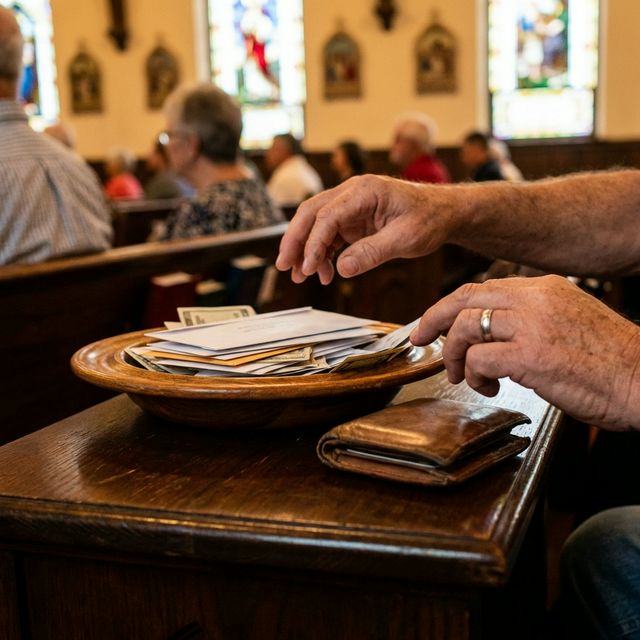
Option 1: Pass it. Take the plate from the person next to you. Pass it to the person on your other side. Done. No one is watching. No one is keeping score. This is the most common thing visitors do and literally nobody thinks twice about it.
Option 2: Hold it for a beat, then pass it. If you want to be less conspicuous (I see you, fellow overthinkers), just hold the plate for a natural moment — the same amount of time everyone else does — and then pass it along. The "hover and pass" is a time-honored tradition among visitors and broke college students alike.
Option 3: Drop something in. If you genuinely want to give, give. A dollar, a five, a twenty — there is no wrong amount. Some people drop in spare change. Some people put in a check. I once saw someone put in a folded note that just said "praying for this church" and honestly, that might be the most valuable thing anyone put in the plate that day.
Option 4: Use the digital option. More and more churches are moving away from the physical plate altogether. Look for a QR code in the bulletin, a "Give" button on the church's website, or a text-to-give number on the screen. Some churches have a box in the lobby. These options exist specifically so you don't have to make a split-second decision while a plate is in your lap.
Red Flags vs. Green Flags
Since we're being practical, here's how to read a church's money culture — because how a church handles giving tells you a lot about what they actually believe.
🟢 Green flags:
✅ The pastor says something like: "If you're visiting, this is not for you — just pass the plate along."
✅ Giving is mentioned briefly and moved on from. No guilt. No theatrics.
✅ Financial reports are available to the congregation (transparency is huge).
✅ The church talks about generosity as a lifestyle, not just a Sunday transaction.
✅ Multiple, private ways to give (online, box in lobby, mail) so there's no public pressure.
🔴 Red flags:
❌ The offering segment lasts longer than the sermon.
❌ The pastor implies that God will bless you financially if you give (that's called "prosperity gospel" and it's worth a whole separate conversation).
❌ You're asked to raise your hand, stand up, or walk to the front to give.
❌ Named envelopes. Tracked giving. Public recognition of big donors.
❌ Anyone — anyone — says the phrase "you can't out-give God" while looking directly at your wallet.

The Part That Might Surprise You
Here's what I didn't understand about church giving until I'd been going for a while:
It's not really about the money.
I know — that sounds like exactly what someone asking for your money would say. But hear me out.
There's a moment in the Gospels where Jesus is watching people put money into the temple treasury. Rich people are dropping in large amounts. And then a widow — broke, alone, with nothing — puts in two tiny copper coins. Basically pennies. And Jesus turns to His disciples and says, "This poor widow has put in more than all the others."
He wasn't measuring the amount. He was measuring the heart.
Generosity in the Bible isn't about percentages or dollar amounts. It's about open hands. It's about saying: I trust that what I have is enough, and I'm willing to share it. Sometimes that's money. Sometimes it's time. Sometimes it's just showing up.
You showed up. That's not nothing.
Your Assignment This Week
Don't worry about the offering plate. Seriously. Take it off the list of things to stress about.
Instead, look at the church's website and find their "giving" page. Not to give — just to read it. Does it explain where the money goes? Is it transparent? Does it feel pressure-free? Or does it feel like a sales funnel?
A church's giving page tells you almost as much as their sermon. If it makes you feel respected and informed, that's a church that gets it. If it makes you feel like an ATM with a soul, keep scrolling.
And when Sunday comes — if you visit — and that plate starts its slow journey down the row toward you? Just pass it. Smile. Breathe. You belong here whether you put anything in that plate or not.
The door was free. The seat was free. The grace was free. Everything that matters was already paid for.