

There is a unique, sweat-inducing panic that only occurs between the hours of 9:30 AM and noon on a Sunday. It’s not the parking lot gridlock or the dread of being forced to stand up and introduce yourself as a visitor. It’s much quieter, much more modern, and it happens right in the middle of the sermon. It’s what I call the Phone Bible App Paranoia.
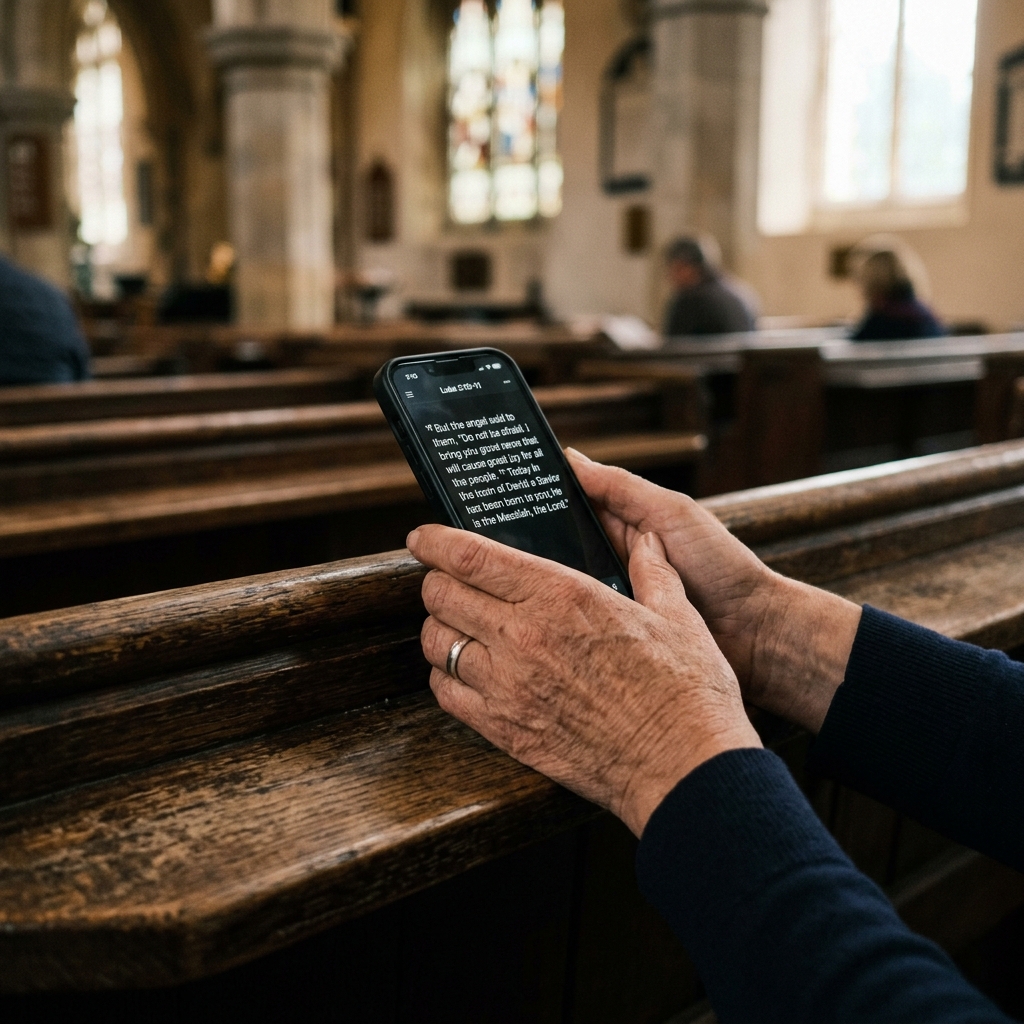
Picture this: The pastor says, “Turn with me to the book of Ephesians,” and a satisfying rustle of paper pages fills the sanctuary—which is just a fancy church word for the big room where everyone sits, because why say 'lobby' and 'auditorium' when you can say 'narthex' and 'sanctuary'? Anyway, you don’t have a physical Bible with you because you’re a modern human who lives in the twenty-first century. So, you pull out your phone. You unlock it, open your Bible app, and look down. But the moment your screen lights up, your brain starts screaming. What if the person behind me thinks I’m checking sports scores? What if the grandma in the next pew thinks I’m swiping on Tinder during the opening prayer? What if they think I’m texting my friends about lunch plans?
Suddenly, instead of listening to the sermon, you are locked in a high-stakes psychological drama. You find yourself tilting your screen at an extreme 45-degree angle so your neighbors can clearly see the holy text. You start nodding aggressively at the screen to indicate deep, spiritual contemplation. You are no longer reading scripture; you are performing the act of reading scripture. If this sounds like you, take a deep breath. You are not alone. Let’s look at some practical, slightly ridiculous, but highly effective ways to navigate using a digital Bible in church without losing your mind.
The Survival Guide
Using your phone for scripture during a service doesn’t have to feel like a covert spy mission. Here are four strategies to help you navigate the digital pews with confidence:
Strategy 1: The Pious Screen Angle (The 45-Degree Tilt)
If you suffer from screen paranoia, master the Pious Tilt. This is the art of angling your phone so that anyone looking from behind or from the side can clearly see the text. Do not hold the phone flat in your lap; that looks like you are hiding something. Instead, hold it at chest level, slightly tilted outward. If someone looks over, they won’t see a text thread; they will see highlighted verses. Just be careful not to tilt it so far that the glare blinds the pastor.
Strategy 2: The Contemplative Nod and Eyebrow Furrow
To combat the perception that you are playing games, you must employ the Contemplative Nod. As you look at your screen, occasionally furrow your eyebrows in deep intellectual thought, nod slowly, and maybe even whisper a silent, contemplative 'ah' to yourself. This communicates to anyone watching that you are not reading a group text about tacos, but rather digesting a complex theological argument about Paul's letter to the Ephesians.
Strategy 3: The Airplane Mode Cloak
The biggest threat to your focus isn’t what other people think; it’s the sudden, loud notification from your fantasy football group chat or a meme from your brother popping up right when the pastor is discussing self-control. Before the service starts, put your phone in Airplane Mode or turn on a strict Focus filter. By blocking all incoming notifications, you remove the temptation to stray and ensure that your phone acts as a Bible, not a portal to the rest of the internet.
Strategy 4: The Analog Backup (Embrace the Paper)
If the anxiety of looking distracted is completely ruining the service for you, there is no shame in going old school. Buy a small, lightweight paperback Bible to keep in your car. It doesn't send notifications, it never runs out of battery, and there is zero ambiguity about what you are reading. Sometimes, the easiest way to solve digital anxiety is to remove the digital element entirely.

The Pivot
It is fascinating that we spend so much energy worrying about the optical illusion of our focus. We are terrified of looking like we are checking out, even when our hearts are actually engaged.
This highlights a deeper struggle: our obsession with external appearance. In church, we often wear a double layer of armor. We want to look like we have it all together, that we are focused, devout, and doing everything right. But scripture tells us that while humans look at the outward appearance, God looks at the heart (1 Samuel 16:7). God isn't looking at your screen angle. He isn't grading you on whether you brought a leather-bound Study Bible or a cracked iPhone screen. He cares about the posture of your heart, not the posture of your phone.
When we worry about what the person behind us thinks of our screen, we are letting social anxiety steal a moment of connection with God. Real worship starts when we stop performing for the pews and start focusing on the altar.
The Landing
This Sunday, if you use a Bible app, do this: put your phone in Focus Mode. Turn it on, look at the scripture, and do not worry about who is watching. If the person behind you thinks you are texting, let them. Your focus is between you and God.
Let’s stop worrying about looking holy, and start focusing on being present.
Keep reading, silence your notifications, and see you next week.