


The Moment You Realize Visiting Was Just Phase One
You did the hard thing. You Googled churches, read the "What to Expect" page, picked an outfit (after agonizing about it for 45 minutes — we've talked about this), and walked through those doors. You survived. The greeter didn't tackle you. The worship music was pretty good. The sermon wasn't weird. You're cautiously optimistic.
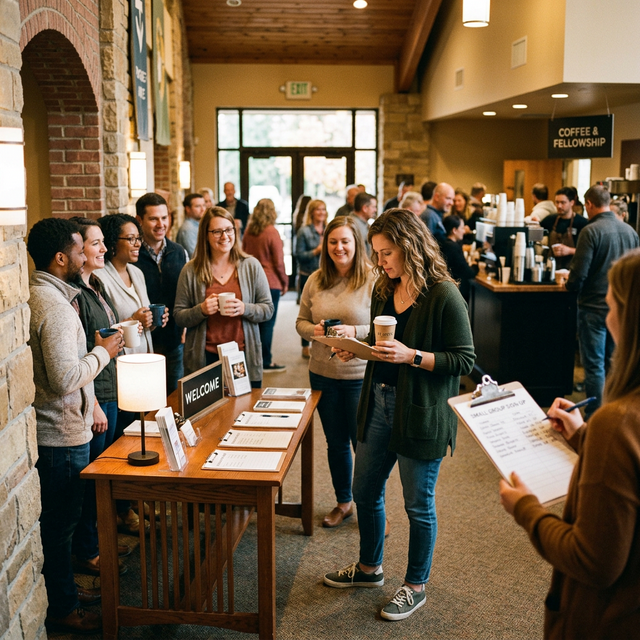
And then — right as you're making your escape through the lobby — someone with a clipboard appears. They're warm. They're smiling. They have pamphlets.
"We'd love to get you plugged in to a small group! It's really where community happens. Can I get your name and number?"
And just like that, your internal alarm system goes from "this was nice" to "I need to fake a phone call and walk very fast to my car."
What Even Is a Small Group?
Let's decode this, because churches are spectacularly bad at explaining their own programs. A small group (also called a life group, home group, community group, connect group, or — my personal favorite — a "discipleship pod") is basically a handful of church people who meet during the week, usually at someone's house, to study the Bible, talk about life, eat snacks, and — in theory — build deeper relationships than you'd get from sitting in a pew on Sunday morning.
Think of it as the difference between going to a concert and joining the band. Sunday morning is the concert. Small group is where they ask you to play bass.
And look, small groups can genuinely be wonderful. Some of the deepest friendships in church life grow out of these rooms. But here's the thing nobody tells you: you don't have to join one on your second visit. Or your fifth. Or your tenth. There is no cosmic timer ticking down.
Why Churches Push Small Groups So Hard
Before we get to the survival guide, it helps to understand why the clipboard people are so enthusiastic. It's not a trap (usually). Most churches genuinely believe — and honestly, the data backs them up — that people who join a small group are far more likely to stick around. It's the difference between "I attend that church" and "I have people there who know my name."
So when a church encourages you to join a small group, most of the time they're thinking: "We don't want this person to fall through the cracks. We want them to feel connected." The intention is usually good. The timing and pressure? That's where it gets dicey.
Because here's what it feels like from the visitor's side: "I just walked in the door. I haven't decided if I'm coming back. And you want me to commit to sitting in a stranger's living room on a Tuesday night, eating hummus, and sharing my feelings? I can barely share an elevator."

The Introvert's Nightmare: A Taxonomy of Small Group Pressure
Not all small group pressure is created equal. Here's a field guide to what you might encounter:
Level 1 — The Gentle Mention: A pastor says "hey, we have small groups, check the website if you're interested." This is fine. This is civilized. This is how it should work.
Level 2 — The Lobby Ambush: Someone with a clipboard catches you between the sanctuary and the parking lot and asks you to sign up. Slightly aggressive, but manageable. A simple "I'm still just checking things out" will usually do.
Level 3 — The Sermon Guilt Trip: The pastor works small groups into the sermon. "If you're not in a small group, you're not really doing church." This one stings because it makes you feel like a spiritual underachiever for wanting to attend at your own pace.
Level 4 — The Auto-Enroll: You filled out a visitor card and now you're getting texts from a small group leader named Chad who wants to meet for coffee. You never signed up for this. Chad seems nice but this feels like a spiritual MLM.
Level 5 — The Membership Gate: The church won't let you become a "member" unless you're in a small group. This is the boss level. It's not inherently wrong — some churches genuinely structure community this way — but for a visitor, it can feel like "you can't even officially belong here unless you agree to weekly vulnerability with strangers."
The Survival Guide: How to Navigate Small Group Pressure Without Panic
Alright. Here's your game plan for when the small group conversation comes up — and it will come up.
1. Know your magic phrase. Here it is: "I'd love to look into that once I get settled." It's warm. It's honest. It doesn't slam the door. And it buys you as much time as you need. Nobody can argue with "once I get settled." You're settling! It's a process!
2. Ask what kind of groups they have. Not all small groups are the "sit in a circle and share your deepest wounds" variety. Many churches have interest-based groups — hiking, book clubs, parenting, serving together. If the idea of a Bible study in someone's living room makes your skin crawl, ask if there's something more activity-based. You might find a group that feels more like doing something together than sharing something together. That's a totally valid entry point.
3. Watch how they handle your "no." This is actually one of the most useful tests of a church's culture. When you say "not yet" to a small group, what happens? Do they say "totally, no rush, we're glad you're here"? Great sign. Do they look concerned, apply more pressure, or suggest that you're missing out on God's plan for your life? That tells you a lot about whether this community respects boundaries.
4. Give yourself a timeline — but make it YOUR timeline. If you find a church you genuinely like after 4-6 consistent visits, trying a small group (even once) isn't a bad idea. But the key word is trying. You're not signing a lease. Go once. See how it feels. If you walk out thinking "that was actually kind of nice," amazing. If you walk out thinking "never again," that's valid data too.
5. Remember that "community" doesn't have to look the same for everyone. Some of us find belonging in a weekly small group. Some of us find it volunteering on the tech team. Some of us find it in a 30-second conversation in the parking lot with one person who remembers our name. All of those count. Don't let anyone define what "deep enough" looks like for you.
The Pivot Nobody Talks About
Here's what I've been turning over in my head lately. The whole small group pressure thing hits so hard because it's touching something real: we actually want to belong somewhere.
That's the cruel irony. The introvert who panics at the thought of a small group isn't panicking because they don't want connection. They're panicking because they do — and the pressure makes the whole process feel transactional instead of organic. Nobody wants to be "plugged in" like a toaster. We want to be known. And being known takes time.
There's this line in Ecclesiastes — "There is a time for everything, and a season for every activity under the heavens." I think we forget that applies to church stuff too. There's a season to observe. A season to show up and just sit in the back. A season to be the quiet person who comes and goes without fanfare. And — when you're ready — a season to open up.
Nobody gets to rush your season.
The Landing
Here's your assignment for this week, and it's a small one: if you're church shopping and someone mentions small groups, don't panic. Just ask two questions:
"What kind of groups do you have?" and "Is there any pressure to join right away?"
The answers will tell you more about that church's culture than any sermon ever could. A church that says "take your time" is a church that understands that belonging is a process, not a product.
And listen — if you've been going to a church for weeks or months and still haven't joined a group? You're not behind. You're not failing at church. You're just finding your pace. And that's allowed.
You showed up. That's not nothing. That's everything.