

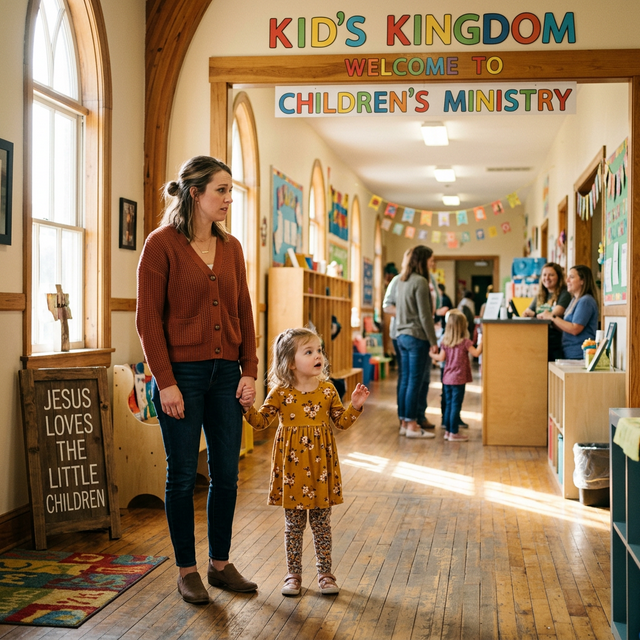
The Parking Lot Negotiation
You finally did it. After weeks of Googling, screenshot-comparing church websites, and having four separate conversations with your spouse that all ended with "we should really find a church," you picked one. You drove there. You parked. You are in the parking lot.
And then your four-year-old asks the question that unravels everything: "Are you coming with me?"
That's when you notice the signs. Literal signs. Cheerful arrows pointing toward "KidZone!" or "Little Lambs Nursery" or whatever aggressively cute name they've given the children's wing. And it hits you: they want you to drop your child off. With people you have never met. In a building you've never been inside. While you go sit in a room full of strangers and pretend to be spiritually present.
Your spouse looks at you. You look at your spouse. Your four-year-old is already unbuckling.
Welcome to the most anxiety-inducing five minutes of any church visit that nobody warns you about.
Why This Hits Different Than Any Other Drop-Off
Here's the thing: you drop your kid off at places all the time. Daycare. School. Grandma's house. Your friend's birthday party where you don't know the other parents but the bouncy house looks safe enough. You've done this.
But church is different, and it's worth naming why it's different.
You don't know anyone. At daycare, you vetted the place. You toured it. You read seventeen Google reviews and asked your neighbor about the teacher-to-kid ratio. At school, there's a principal and a front desk and a system. At church? You clicked on a website, drove to a building, and now a person in a lanyard is smiling at you and reaching for your child.
You can't verify anything in real time. At most churches, the children's area is separate from the main service. You can't peek in. You can't hover. You're in another room, possibly another floor, listening to a sermon about trust while your brain is running a background loop of "Is my kid okay? Is my kid okay? Is my kid okay?"
The stakes feel enormous. This isn't just a Saturday playdate. For many parents, this is the first time they're trying to build something spiritual for their family. If it goes wrong — if your kid screams, if the drop-off is chaotic, if the vibe feels off — you're not just leaving a church. You're shelving the entire church search for another six months.
What Actually Happens at Most Church Drop-Offs (A Demystification)
Let me walk you through what the children's ministry check-in process usually looks like at most mid-to-large churches, because knowing the choreography makes it 80% less terrifying.
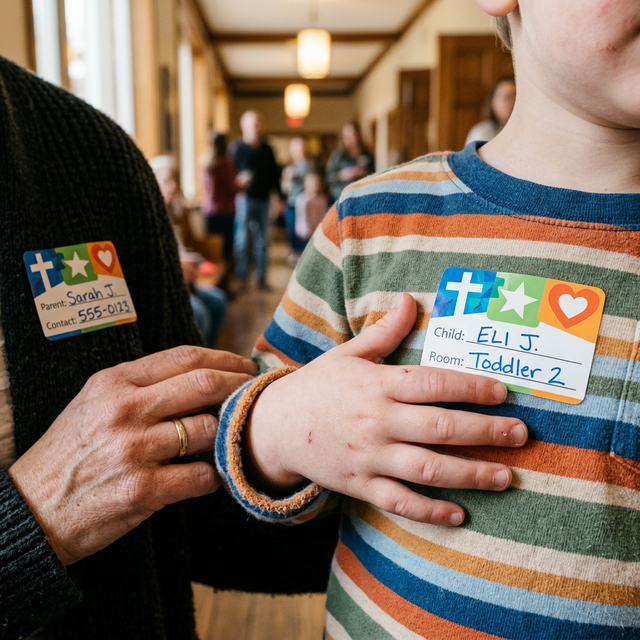
Step 1: The Check-In Kiosk. Most churches now use a digital check-in system — think iPad on a stand. You type in your name, your kid's name, and any allergies or special needs. The system prints two matching stickers: one for your kid and one for you. This is important. That matching sticker means nobody can pick up your child without the corresponding tag. It's not Fort Knox, but it's a real security measure.
Step 2: The Handoff. A volunteer — usually someone who's been background-checked (more on that in a second) — greets your child by name, because they just read the sticker. They'll tell your kid what's happening: "We're going to do a craft and hear a story and have goldfish crackers!" Your child will either go willingly or look at you like you've suggested they move to another country.
Step 3: The Escape. This is the part nobody prepares you for. Once your kid is in, you leave. You walk away. You hear a muffled cry that may or may not be your child. You sit down in the main service and try to remember why you came here. This is normal.
Step 4: The Buzz. If your kid is having a meltdown or needs you, many churches have a text or buzz system. Your phone vibrates, or a number flashes on a screen at the front of the room. It's discreet. It works. And honestly? Most of the time, it never goes off.
The Questions You're Afraid to Ask (So I'll Ask Them for You)
"Are the volunteers background-checked?" At most established churches: yes. Reputable churches run background checks on all children's ministry volunteers and require training. But you're allowed to ask. "Do you run background checks on your children's workers?" is not a rude question. It is a responsible question. Any church that gets offended by it is telling you something important about their culture.
"Can I stay with my kid?" Usually, yes — at least for the first visit. Most children's ministry leaders will let a parent hang back in the room during the first week. If they don't offer, ask. "Would it be okay if I stayed with her today since it's our first time?" No reasonable person says no to that.
"What if my kid won't stop crying?" They'll come get you. That's the deal. Children's ministry volunteers are trained for this. They'll try to comfort your child, distract them, engage them — but if it's not working, they'll text you or come find you. Your kid will not sit in a corner sobbing while you're in the sanctuary wondering what happened.
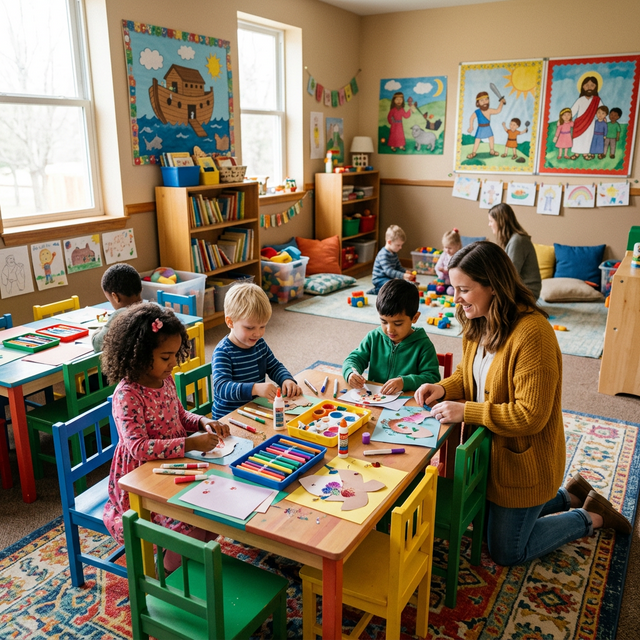
"What are they teaching my kid?" This one matters. The children's lesson is usually a simplified, age-appropriate Bible story — Noah's Ark for the little ones, something with more nuance for the older kids. If you want to know what your kid will hear, ask for the curriculum name. Many churches use published programs (like Orange or Gospel Project) that you can look up online in advance. And if you're just visiting, one morning of flannel-graph Moses is not going to undo your parenting.
"What if I don't want to drop them off?" Then don't. Seriously. Many churches have a "family service" option or simply don't mind if kids sit with parents. Your kid might squirm through the sermon, and that's fine. You're not obligated to use the children's program. But know that the option exists for a reason — it's designed to give you a chance to actually be present for one hour while someone entertains your kid with Bible stories and an unreasonable amount of glitter glue.
The Real Fear Underneath All of This
Can I be honest about something? The drop-off anxiety isn't really about logistics. It's not about stickers and check-in kiosks and whether they have enough goldfish crackers.
It's about trust.
You're trusting a community you haven't joined yet with the most important person in your life. You're trusting strangers with your child's safety, their emotional experience, and — on some level — their first impression of what "church" even means. That's a massive ask for a first visit.
And here's what I want you to hear: it's okay to not be ready. It's okay to visit a church three times before you use the children's program. It's okay to keep your toddler on your lap during the sermon. It's okay to ask seventeen questions at the check-in desk while a line forms behind you. You're not being difficult. You're being a parent.
There's a moment in Psalm 127 where David writes that children are "a heritage from the Lord." Heritage. Not a burden, not an inconvenience, not a logistical problem to be solved on Sunday mornings. A heritage — something precious, entrusted, worth protecting. The fact that you're anxious about this? That's not weakness. That's stewardship. You're guarding something God gave you.
And any church worth its salt will honor that instinct, not rush you past it.
Your One Thing This Week
If you're church shopping with kids and the drop-off question has you stuck: call the church before you go. One phone call. Three minutes. Ask these four questions:
1. "Do you run background checks on your children's volunteers?"
2. "Can I stay with my child during the first visit?"
3. "What curriculum do you use for kids?"
4. "What's your policy if my child is upset?"
That's it. Four questions. You'll know within sixty seconds whether this church takes your kid's safety as seriously as you do. And if they can't answer clearly or make you feel weird for asking? Cross them off the list. That's data.
The church search with kids is harder. It's slower. It has more moving parts and more goldfish cracker negotiations than you ever imagined. But here's the good news: a church that's good for your family will welcome your caution. They'll answer your questions without flinching. They'll let you hover. They'll understand that trust is built, not assumed.
The right church doesn't just want you to show up. It wants your kids to want to come back.