

The Sound That Stopped the Scroll
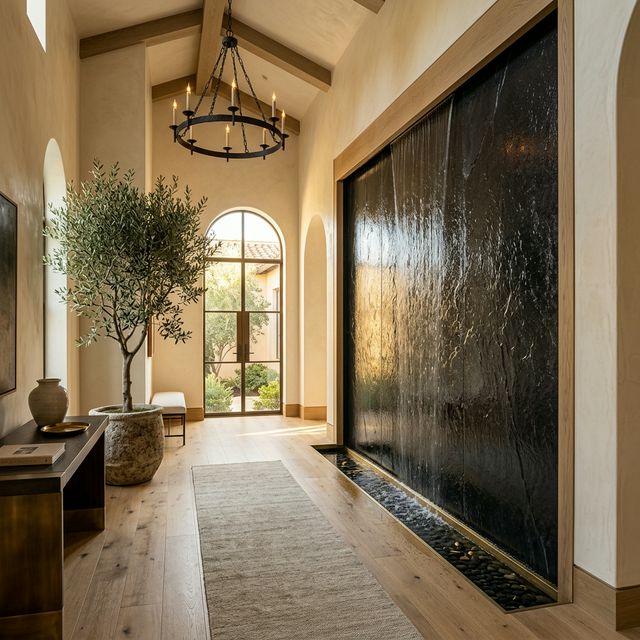
I was walking through a show house in Santa Barbara last month — the usual parade of beautiful rooms trying very hard to be memorable — when I turned a corner into an entryway and stopped. Not because of the Venetian plaster (though it was exquisite). Not because of the hand-forged iron chandelier (though it deserved a moment). I stopped because I heard water.
A narrow channel of it — a rill, the designer called it, borrowing the term from Moorish garden architecture — ran along the base of the entryway wall, no wider than a bread knife, disappearing beneath a honed basalt threshold into a hidden reservoir. The sound was barely there. A whisper of movement. A pulse.
"Most people don't notice it for thirty seconds," the designer told me. "But everyone notices they feel calmer. They just don't know why."
Welcome to the quietest revolution in interior design.
The Return of Water to the Room
For centuries, water was a central design element in the world's most revered spaces. The Alhambra's Court of the Lions. The reflecting pools of Persian gardens. Roman atriums with their impluvium — a shallow pool in the center of the home that caught rainwater and light simultaneously. Water was not decoration. It was infrastructure for the soul.
Then we forgot. We traded fountains for flat-screens. We replaced the sound of moving water with the hum of HVAC systems and the ping of notifications. And our rooms got louder while our spirits got depleted.
In 2026, the pendulum is swinging back — hard. Designers across the board, from luxury firms in Milan to boutique studios in Portland, are reintegrating water into residential interiors. Not the gaudy tabletop fountains of the 1990s with their plastic finishes and blue LED lights. No. This is water as architectural material.
What It Actually Looks Like
The new indoor water features fall into three categories, each more compelling than the last:
The Wall Spill. A thin, nearly invisible sheet of water cascading down a surface of honed natural stone — black basalt, grey limestone, or rough-cut travertine. The stone darkens where the water touches it, creating a living, shifting surface that changes with the light. Mounted flush to the wall, the mechanism is hidden behind the stone. What you see is a wall that seems to breathe. What you hear is rain that never stops.
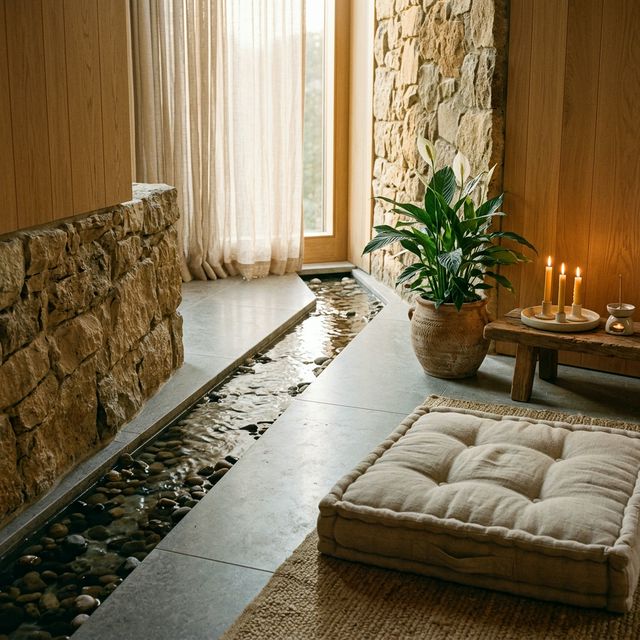
The Rill. Borrowed from Islamic garden design, a rill is a narrow channel of slowly moving water embedded into the floor. In 2026, designers are running rills along entryway walls, around the perimeter of meditation rooms, and even as room dividers in open-plan spaces. The material of choice is typically honed concrete or hand-cut slate, and the water depth is often less than half an inch. It's a river with the manners of a whisper.
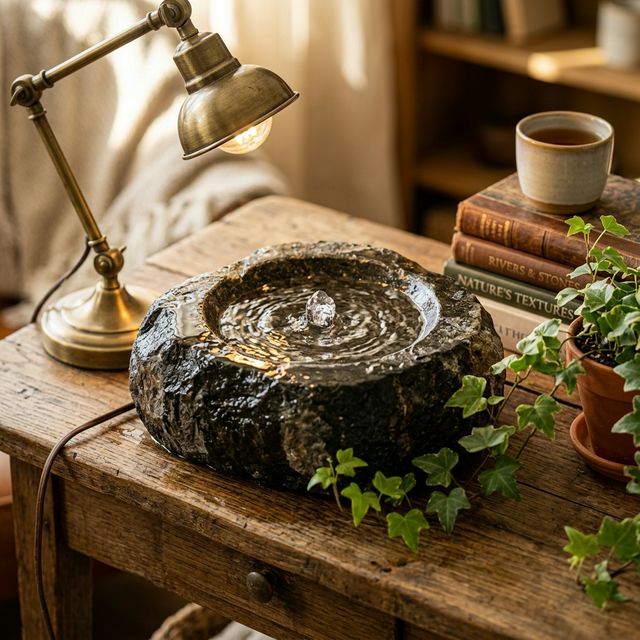
The Basin. Small, sculptural stone fountains placed in living areas — think of a hollowed lava stone with a gentle bubble at its center, or a hand-carved marble bowl with water that barely crests the lip. These are the most accessible entry point: they plug in, they're portable, and they transform the acoustic character of a room in seconds.
The Science Behind the Silence
This isn't just aesthetics. There's a reason hospitals put fountains in their lobbies and therapists use white noise machines shaped like waterfalls. Research in psychoacoustics has consistently shown that the sound of slowly moving water reduces cortisol levels, lowers perceived stress, and — most fascinatingly — makes rooms feel larger. The brain interprets the sound of water as open space, as nature, as safety.
In an era of digital noise saturation, our nervous systems are quite literally begging for the sound of something that isn't a notification. A well-placed water feature doesn't add sound to a room. It replaces sound. It creates what acoustic designers call a "masking frequency" — a gentle, consistent tone that absorbs the chaos around it.
Your room doesn't need to be quieter. It needs to be wiser about what it says.
The Pivot: He Leads Me Beside Still Waters
I've read Psalm 23 a thousand times. "He leads me beside still waters. He restores my soul." I always read it as metaphor — God's provision is like a peaceful stream. Lovely imagery. File under: comfort.
But standing in that Santa Barbara entryway, listening to water move through stone, I realized David wasn't being metaphorical. He was being architectural.
David was a shepherd. He knew that sheep won't drink from rushing water — the sound frightens them, and the current can pull them under. A good shepherd doesn't bring the flock to a raging river and say, "Drink or don't." He finds still water. Calm water. Water that speaks gently enough for the exhausted to approach.
And isn't that exactly what our homes should do?
We live in a culture of rushing water. The news cycle is a torrent. Social media is a rapids. Our work inboxes are flash floods. And we come home — to our supposed sanctuaries — and fill them with more noise. More screens. More stimulation. We bring the flock to the river and wonder why no one feels restored.
A home that incorporates the sound of still, moving water is making a theological statement whether it knows it or not. It's saying: this space is designed for restoration, not performance. This room exists to calm, not to impress.
The Materials That Matter
If you're going to bring water into your home — and you should — the materials around it need to be worthy of the element they're hosting:
Honed natural stone is the gold standard. Basalt, limestone, travertine, and slate all age beautifully when they interact with water. Over time, the stone develops a patina — mineral deposits, slight color shifts — that makes the surface look like it has always lived with water. This is not a bug. This is the point.
Concrete, particularly hand-poured and sealed with beeswax or natural sealant, gives a more modern, industrial feel. It pairs beautifully with warm wood and brass hardware.
Copper basins and spouts develop a green patina over time that is nothing short of magnificent. A copper fountain in a room with deep green walls and warm wood? That's not a design choice. That's a poem.
Avoid: resin, plastic, anything with LED color-changing features, and any fountain that plays "sounds of nature" from a speaker. If the water needs a soundtrack, it's not real enough.
How to Start
The Gateway Drug: A Stone Basin Fountain. Start with a small, sculptural stone fountain on a console table or in a reading nook. Look for hand-carved basalt or river stone with a simple recirculating pump. Budget: $150-$400. Impact: immediate. The moment you plug it in, the room changes temperature. Not literally — but the atmosphere shifts. Something in your shoulders releases.
The Next Step: A Wall-Mounted Water Feature. Commission or purchase a wall spill in natural stone. These are typically 3-5 feet tall, mounted like art, with a hidden reservoir at the base. They run on standard electrical outlets. The stone should be unpolished — honed or natural cleft — so the water can grip the surface and cascade slowly rather than sheeting off. Place it in a hallway, dining room, or wherever you want to create an arrival moment.
The Full Commitment: A Rill. If you're renovating, talk to your designer about integrating a floor-level water channel. This requires waterproofing, a recirculating pump, and careful drainage planning, but the result is extraordinary. A rill in an entryway tells every person who crosses your threshold: slow down. You're safe here. This house has a different pace.
The One Rule: The water must make sound. A still reflecting pool is beautiful, but it doesn't do the acoustic work. The water needs to move — even barely. Because the magic isn't in what you see. It's in what you hear. And what you hear, if you're listening, is a room that has learned to speak in the oldest language there is.
A room beside still waters. Where your soul, at last, gets restored.