

I need to tell you about a chandelier I saw last week that made me question every lighting decision I've ever made.
It was tiered — three concentric rings of burnished brass, each holding frosted glass globes that glowed like captured moons. It hung in a double-height living room above an emerald velvet curved sofa, and the whole scene looked less like interior design and more like a benediction.
Neo Deco lighting has entered the chat, and it is not here to be subtle.
The Brass Awakening
If you've scrolled through any design publication this year without encountering at least seven brass chandeliers, I need to know what corner of the internet you've been hiding in — and whether they have room for one more.
Brass in 2026 isn't the polished, mirror-finish brass of your grandmother's powder room. This is aged brass. Burnished brass. Brass that looks like it's been having a long, thoughtful conversation with time itself. It's warmer. It's wiser. It has the kind of patina that says, "Yes, I've seen things, and I'm more beautiful for it."
And the designers are pairing it with everything that matters: deep emerald walls that make the metal sing, oxblood lacquer that gives it drama, and black marble that makes it the undisputed star of the room.
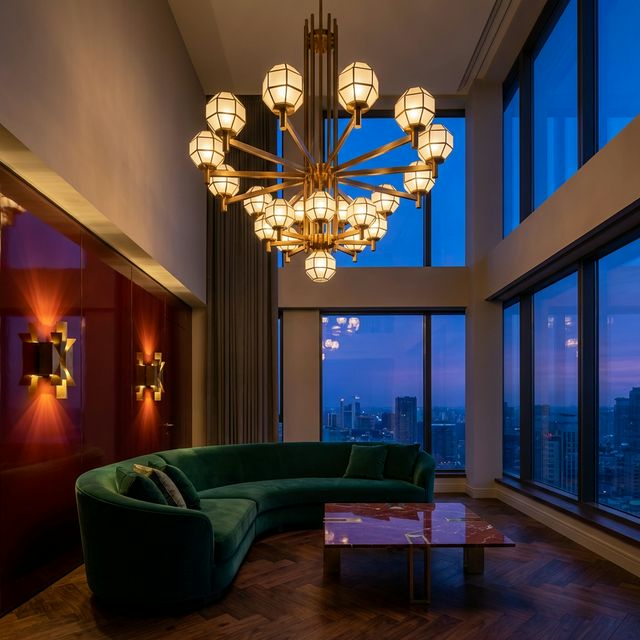
The Geometry of Glow
Here's what separates Neo Deco lighting from every other brass-adjacent trend that's come and gone: structure.
These aren't floppy, organic, "I found this driftwood and screwed a bulb into it" fixtures. (And yes, I'm looking at you, 2018.) These are pieces with intention. Geometric wall sconces with fluted arms that cast fan-shaped patterns of light across velvet walls. Tiered chandeliers that look like Art Deco wedding cakes, each layer a deliberate descent from brightness to shadow. Frosted ribbed glass that takes a bare bulb and turns it into something that whispers instead of shouts.
The fluting alone is enough to make a grown designer weep. Vertical ridges on brass arms that catch the light in parallel lines — like a pinstripe suit for your walls. It's light architecture, and it's magnificent.
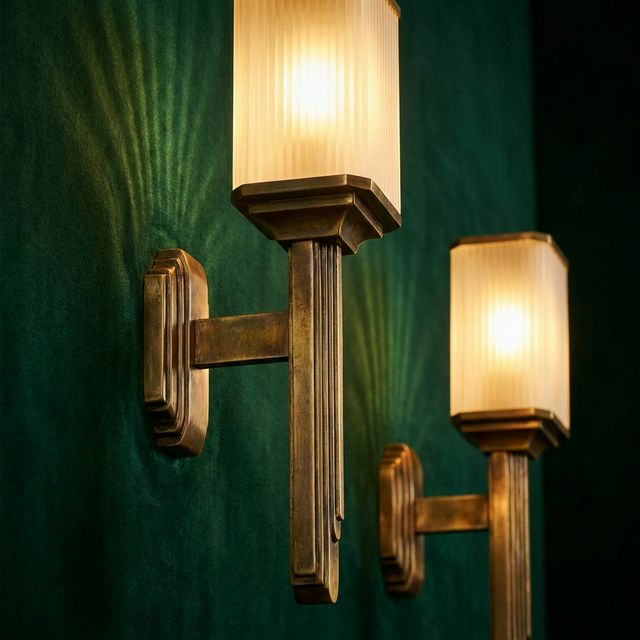
The Console Altar
But it's not just about what hangs from the ceiling.
The Neo Deco vignette has become its own art form — and the console table is its canvas. Picture this: a dark lacquered console against an oxblood wall. A sunburst mirror in gold radiating above it like a secular halo. On the surface: a brass table lamp with a frosted dome shade, a stack of oversized design books, an emerald velvet box with brass hardware, and a crystal decanter on a gold tray catching the last of the evening light.
It's a scene. It's a statement. It's a room within a room that says: the person who curated this corner takes their life seriously, but not too seriously, because there's bourbon involved.
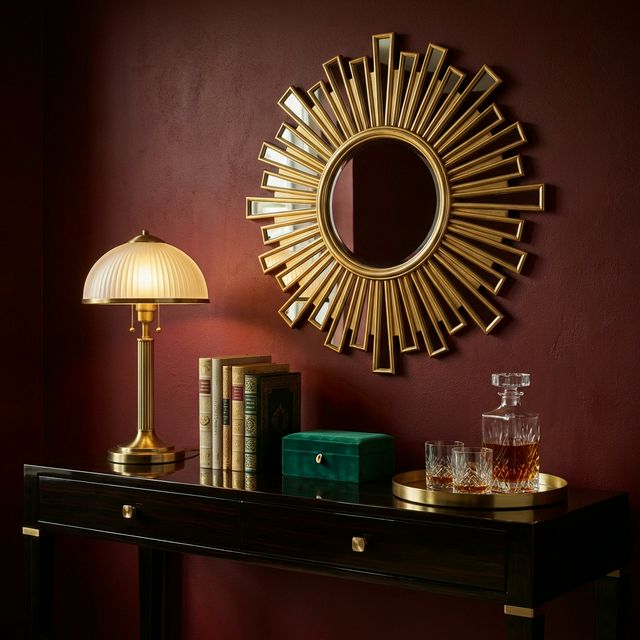
The Lamp Unto My Feet
And here's where it gets personal — because light always does, eventually.
I've been thinking about why these fixtures move me as much as they do, and I think it comes down to this: they reflect. A frosted glass globe doesn't hoard the light. It receives it, softens it, and gives it back to the room in every direction. A burnished brass arm doesn't just hold a bulb — it catches the glow and multiplies it, scattering warm gold across walls and floors and faces.
The fixture doesn't generate the light. It was only ever designed to carry it.
"Your word is a lamp for my feet, a light on my path." — Psalm 119:105
I think that's what the best rooms do — and the best people do. We aren't the source. We were never supposed to be. We are the frosted glass. We are the burnished brass. We are the fluted arms and the geometric frames designed to receive something brighter than ourselves and scatter it in ways that make every corner of the room feel warmer.
The world doesn't need more people generating their own light. It's exhausting, and frankly, the wattage is never enough. What it needs is more people willing to be fixtures — positioned, intentional, beautifully crafted — who take the light they've been given and reflect it without distortion.
That Neo Deco chandelier I saw? It was stunning not because of the bulbs inside it. It was stunning because of the brass around them — the structure that held the light up, aimed it outward, and turned a dark room into something that felt like a cathedral.
Be the brass, not the bulb. The light was never yours to generate. It was yours to carry.
Grace Montgomery is the curator of Living Sanctuary, where high design meets higher truth. She believes every room deserves lighting that makes guests gasp, and every soul deserves a reminder that it was made to glow.