

The Ceiling Has Been Waiting for You
I was scrolling through Pinterest last Tuesday — something I do with the reverence most people reserve for morning prayer — when I noticed a pattern. Not the chevron kind (though those were there too). A behavioral pattern. Designers everywhere, from Brooklyn brownstones to São Paulo penthouses, were looking up.
Not metaphorically. Literally up. At their ceilings. And what they were doing to those ceilings made me set my espresso down and whisper, "Finally."
We have entered the era of the Statement Ceiling — what designers are now calling the Fifth Wall — and it is, without exaggeration, the most exciting thing happening in interior design right now. While we've spent years agonizing over backsplash tiles and accent wall colors, the largest uninterrupted surface in every room has been sitting above us in flat builder-grade white, quietly weeping.
What Exactly Is Happening Up There
The Fifth Wall movement isn't one thing. It's a constellation of techniques converging at once, and that's what makes it so electric. Let me walk you through what the scouts are seeing:
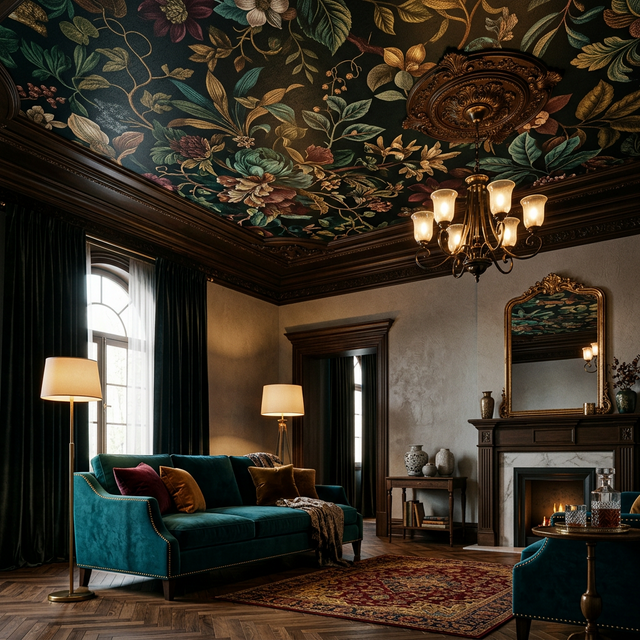
Wallpapered ceilings are leading the charge. We're talking William Morris-scale botanical prints — oversized dahlias and twisting wisteria — applied overhead to create what feels less like a room and more like standing inside a jewel box. The LA Times just called it "the boutique hotel effect for your actual home," and they're not wrong.
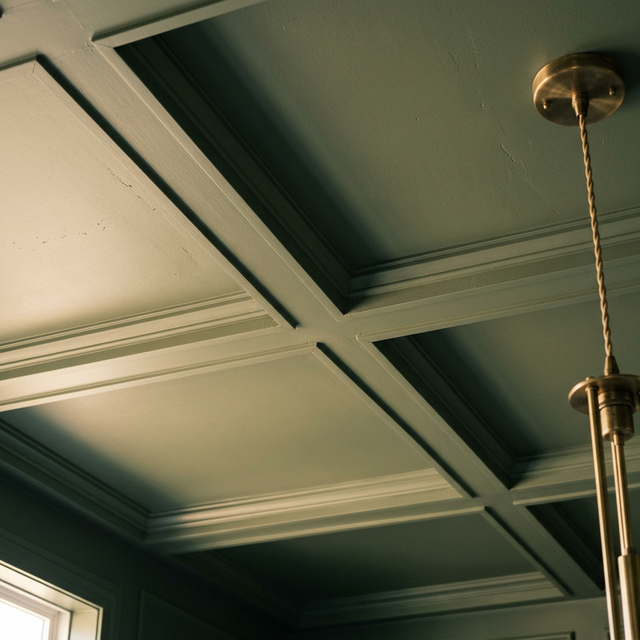
Decorative molding is having its own renaissance. But forget your grandmother's fussy crown molding (well, actually, hold that thought — Grandma Chic is also having a moment, but that's another post). The 2026 version is clean-edged, wide-profile, and often painted in a contrasting color — think matte black picture-frame molding on a deep sage ceiling. Architectural drama without the architecture degree.
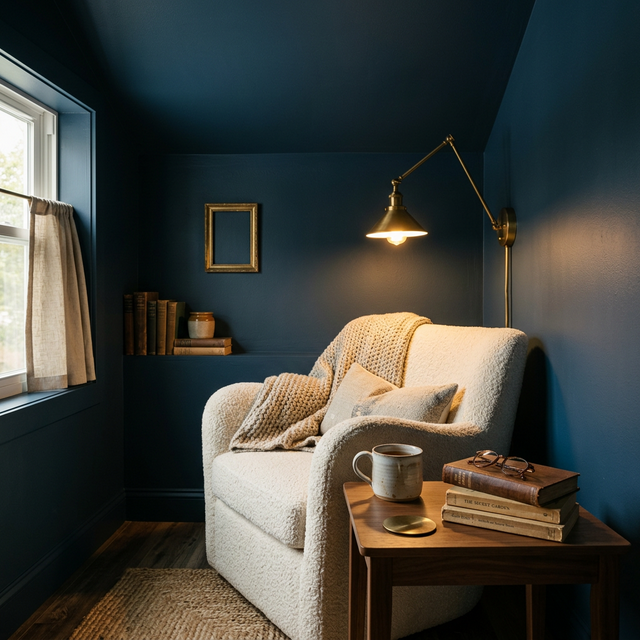
Bold paint — and I mean bold — is being applied to ceilings with the confidence of someone who has finally realized that "ceiling white" is not a commandment. Deep navy. Burnished terracotta. Forest green so dark it reads as velvet. Designers are calling it "drenching" — extending the wall color up and over the ceiling to envelop the entire room in a single saturated hue.
And then there's the maximalist play: murals. Hand-painted or digitally printed ceiling murals that transform a dining room into a Baroque chapel or a nursery into a night sky. One studio in Milan is currently booked eighteen months out for their bespoke sky-ceiling installations — clouds rendered in sixteen layers of pigmented plaster.
The Specifics That Matter
Here's where Grace gets particular, because the details are everything.
The wallpapers driving this trend aren't your mother's florals. Farrow & Ball's "Hummingbirds" pattern — a dense, moody garden scene against a nearly-black ground — has become the designer's ceiling paper of choice. It costs roughly $350 per roll and it is worth every cent, because when you lie on your sofa and look up, you want to feel like you're inside a Caravaggio painting, not a dentist's office.
For molding, the material shift matters. Medium-density fiberboard (MDF) has replaced traditional plaster in most installations — it's lighter, more precise, and takes paint like a dream. The profile trending hardest is what trim artisans call a "Shaker panel" — flat, rectangular, geometric — applied in grid patterns across the ceiling surface. When painted in the same color as the ceiling itself, it creates shadow-play that changes with the light throughout the day.
The color palette for drenched ceilings leans heavily into what Benjamin Moore calls their "Deepened Naturals" collection: Salamander (a near-black green), Templeton Gray (a sophisticated blue-gray), and Newburyport Blue (a rich, stormy navy). The key is matte or dead-flat finish — any sheen catches light and reveals imperfections. Flat paint on a ceiling is generosity. It forgives.
Why Now? The Psychology of Looking Up
Interior psychologists — yes, that's a real discipline — have a theory about why statement ceilings are surging now. After years of screens pulling our gaze down, our homes are being designed to pull it up. There's research from the University of Minnesota suggesting that ceiling height and visual complexity above eye level directly affect our capacity for abstract thinking. Higher, more detailed ceilings correlate with more creative thought.
But I think there's something simpler happening too. We're tired of safe. We painted our walls greige. We chose the neutral sofa. We played it safe on the backsplash. And now, staring at a blank white ceiling, we're realizing that safety is boring — and boring is the one sin a home should never commit.
The ceiling was always the most daring place to make a statement because it requires commitment. You can't half-commit to a wallpapered ceiling. You're either in or you're out. And that kind of decisiveness? In a world of beige equivocation? It's thrilling.
The Upward Glance
Here's where I can't help myself.
The Sistine Chapel wasn't Michelangelo's idea. Pope Julius II essentially told him, "Paint my ceiling," and Michelangelo — who considered himself a sculptor, not a painter — argued against it. He didn't want to look up. He didn't want to crane his neck for four years on a scaffold sixty feet in the air. He wanted to stay eye-level, working in marble.
But the ceiling changed him. The act of painting upward — of creating beauty in the space between earth and heaven — transformed his understanding of what art could be. The ceiling wasn't a leftover surface. It was the most important one. Because it's the one that draws the eye toward something greater than itself.
"I lift up my eyes to the mountains — where does my help come from?" the psalmist wrote in Psalm 121. And I don't think it's a coincidence that the most spiritually resonant spaces in history — cathedrals, mosques, temples — lavish their greatest artistry on what's above. The ceiling is where the sacred lives. It's the boundary between our world and the one we're reaching for.
When you paint your ceiling navy blue with gold-leaf constellations, you're not just being trendy. You're doing something humans have done for millennia — you're turning your gaze upward and declaring that there is something worth looking up to.
How to Start (Without Losing Your Mind)
If you're ready to treat your ceiling like the canvas it's been begging to be, here's your entry strategy:
Start small: A powder room. Its ceiling is probably five feet by five feet. Wallpaper it with something dramatic — a dark floral, a celestial map, a bold geometric. It costs under $200 in materials and the impact is disproportionately enormous.
Go tonal: If wallpaper feels too bold, pick your wall color and extend it to the ceiling. The "drenching" technique works best in rooms with good natural light — a bedroom, a reading nook, a home office. Benjamin Moore's Salamander or Farrow & Ball's Hague Blue are designer-approved starting points.
Add architectural interest: Apply Shaker-panel MDF molding in a grid pattern. Paint it the same color as your ceiling for a subtle, sophisticated texture. Total materials cost for a standard bedroom ceiling: roughly $150-250 in MDF strips and construction adhesive.
Commission a mural: This is the luxury move, but local artists are increasingly offering ceiling mural services starting around $1,500. Think clouds, botanicals, star maps, or abstract color fields. It's a one-time cost for a lifetime of looking up and smiling.
Whatever you choose, remember this: flat-finish paint is non-negotiable on ceilings. It's the single most important technical detail. Eggshell and satin belong on your walls and trim. Your ceiling wants matte. Trust Grace on this one.
Now go look up. Your ceiling has been waiting.