

The Room That Remembers
I need to tell you about a living room I saw this week that made me sit down on my own couch and have a moment.
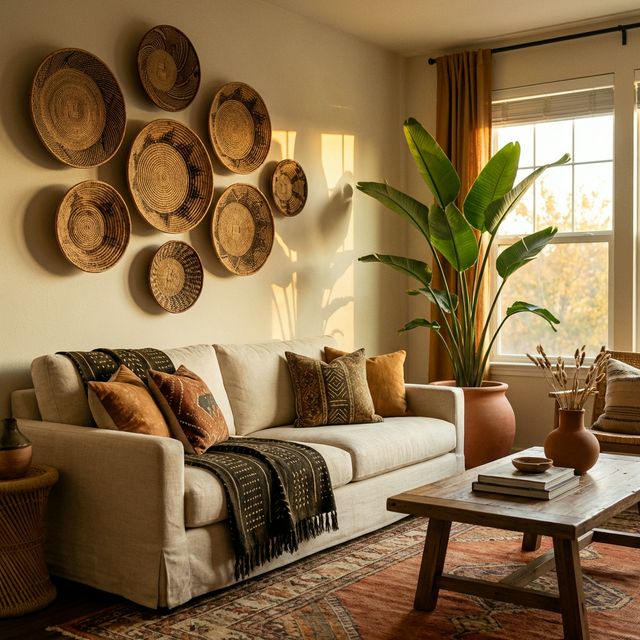
It had a cream linen sofa — nothing revolutionary there — but draped across the back was a Malian mudcloth throw in deep charcoal and gold, the geometric patterns so precise they looked like someone had written a prayer in a language older than English. On the wall behind it, a cluster of Tonga baskets from Zimbabwe — woven so tight you could practically hear the conversation of the women who made them — arranged in a constellation that turned a blank wall into an inheritance.
And in the corner, a Bird of Paradise plant the size of a small ambition, sitting in a hand-coiled terracotta pot that had clearly never been anywhere near a factory.
This is Afrohemian decor. And it's not just trending on Pinterest — it's trending in the souls of people who are tired of living rooms that have no accent.
What Afrohemian Actually Means (And What It Doesn't)
Let me be precise, because this matters. Afrohemian isn't "buy a random African mask at HomeGoods and call it cultural." That's tourism. This is residency.
Afrohemian design intentionally centers African artistic heritage as the foundation of the room — not the accent, not the afterthought, the foundation. Then it layers in bohemian comfort: the linen, the plants, the lived-in texture, the sense that this room has hosted both laughter and tears and isn't precious about either.
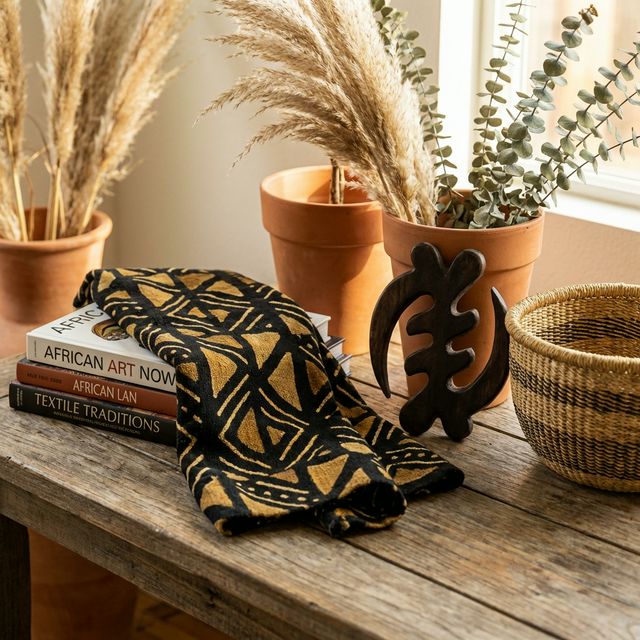
The textiles aren't decorative filler. A mudcloth throw from Mali — bogolanfini, if we're being proper — is cotton hand-dyed with actual fermented mud, using techniques passed down through generations of women who understood that art isn't separate from daily life. Each geometric pattern has a name. Each name tells a story. When you put that on your sofa, you're not accessorizing. You're hosting history.
Kuba cloth from Congo. Ankara wax prints from Nigeria. Kente from Ghana, originally reserved for kings, each color block carrying a distinct meaning that the weaver chose with intention. These aren't fabrics. They're conversations that happen to be made of thread.
The Palette That Comes from the Earth
Here's what I love about the Afrohemian color story: it doesn't come from a Pantone deck. It comes from the ground.
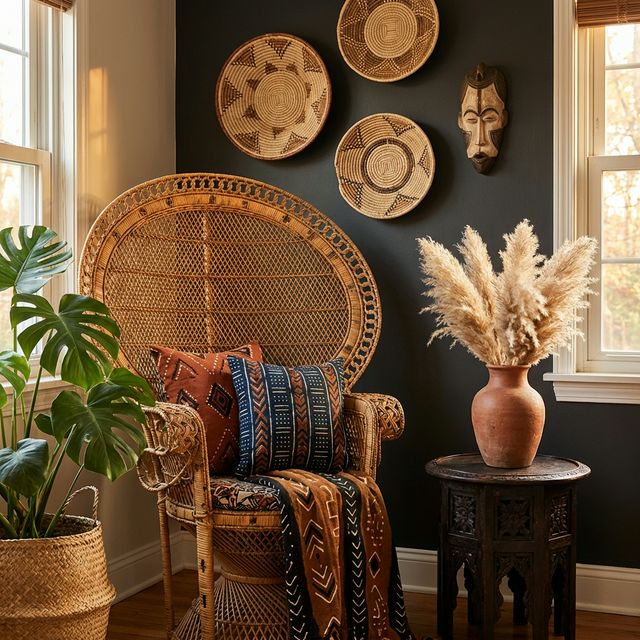
Terracotta — real terracotta, the color of sun-baked clay, not the sad orange that Home Depot calls terracotta. Burnt sienna that looks like it remembers the kiln. Mustard yellow the shade of turmeric freshly cracked. Olive green deep enough to nap in. And then — this is where it gets brilliant — bold black as a dramatic anchor. A black accent wall behind a cream sofa layered in gold-and-charcoal mudcloth isn't trying to be edgy. It's trying to be honest. It's the visual equivalent of someone who is both gentle and unshakable.
And against those earthy tones, occasional shots of deep indigo — the color of Nigerian Adire cloth, tie-dyed by Yoruba women using techniques that predate most European fashion houses by centuries. Indigo that doesn't apologize for being dark. Indigo that says, I've been beautiful this long and I'm not stopping now.
The Wall as Altar
The detail that separates Afrohemian from regular boho is what happens on the walls. In standard bohemian decor, the wall gets a macramé hanging and a pothos vine and we call it done. In Afrohemian design, the wall becomes a narrative surface.
I'm seeing Tonga and Binga baskets — hand-woven in Zimbabwe from ilala palm — grouped in clusters of five or seven above sofas and headboards. Each one slightly different. Each one made by a specific person whose hands knew the pattern from muscle memory. Arranged together, they create what interior designers call a "gallery wall" but what I'd call a chorus. Individual voices that make sense together.
Then there are the Adinkra symbols — Akan ideograms from Ghana, each one encoding a concept. The Sankofa bird, looking backward while flying forward: go back and get it. Gye Nyame, the symbol for God's supremacy. These show up in wall art, carved wood pieces, and printed textiles, and they turn a room from decorated to dedicated.
And the modern portraits — abstract paintings and digital art of African women in vivid headwraps, rendered in terracotta and gold and deep violet. Art that says: the beauty in this room has a face, and she has always been here.
Why This Trend Is Actually a Theology
Here's where Grace Montgomery gets personal.
I think Afrohemian decor is resonating right now because we are starving for rooms that know where they come from. We've spent a decade building homes that could belong to anyone — all those white walls, those generic gallery prints from Target, those "modern" spaces that look like they were designed by an algorithm with commitment issues. We made our rooms universal and, in the process, made them anonymous.
Afrohemian is the opposite of anonymous. Every object in the room has a provenance. That basket was woven in Binga. That cloth was dyed in Bamako. That carving was shaped in Kumasi. The room doesn't just have a style — it has a genealogy.
And that, friends, is biblical.
The Scriptures are obsessed with provenance. "I am the God of Abraham, Isaac, and Jacob" — not "I am a generic deity for general purposes." Every genealogy in Matthew, every city named in Acts, every "from the tribe of" in Romans — God is a God of specifics. He doesn't do generic. And He doesn't expect your home to, either.
When you hang a mudcloth on your wall that was made by a specific woman in a specific village using a specific technique handed down through specific generations, you are participating in the same kind of sacred specificity that runs through every page of scripture. You're saying: this beauty came from somewhere. It cost someone something. And I honor that.
That's not decorating. That's communion.
How to Begin Your Own Homecoming
You don't need to overhaul your entire living room. Start with one piece that has a story.
The First Conversation: A single mudcloth throw pillow — authentic bogolanfini, hand-dyed, not a screen-printed knockoff. Put it on your most neutral piece of furniture. Watch how it changes the temperature of the entire room. Suddenly the space has an opinion.
The Chorus on the Wall: A grouping of three to five woven baskets. Tonga baskets from Zimbabwe, Bolga baskets from Ghana — browse Etsy shops run by African artisans and cooperatives. Arrange them above your sofa in an organic cluster. It's a gallery wall, but one that sounds like something.
The Anchor: One piece of carved or printed wall art that carries an Adinkra symbol or features a portrait rooted in African artistic traditions. Not mass-produced. Something made by a specific hand. Let it be the thing that stops visitors mid-sentence.
And then — because this is Afrohemian — let everything else breathe. The linen. The plants. The imperfect, collected, lived-in feel of a room that invites you to take your shoes off and stay awhile.
Because the most beautiful rooms on earth aren't the ones that were styled. They're the ones that were inherited — layer by layer, story by story, generation by generation. And if your inheritance doesn't hang on your walls yet, it's not too late to start collecting it.
A room that knows where it came from is a room that knows where it's going.