

The Color That Started a Fight
IKEA — IKEA, the company that convinced an entire generation that adulthood was a flat-pack bookshelf and a bag of frozen meatballs — has named their 2026 Color of the Year Rebel Pink.
And honestly? I've never been more proud of a Swedish furniture conglomerate.
Because Rebel Pink isn't blush. It isn't millennial pink. It isn't the dusty, apologetic pink of a home that's trying not to offend anyone. This is hot pink. The kind of pink that walks into a neutral-toned open-concept living room and says, "I'm sorry, were you going for a vibe? Because you landed on 'dentist's office.'"
And it's not alone. It brought friends. Cobalt blue that looks like it was stolen from a Matisse painting. Marigold yellow that has the audacity to be cheerful. Together, they're staging a full-scale revolt against the Sad Beige Industrial Complex, and I am here for every glorious, clashing minute of it.
Ettore Sottsass Is Laughing From the Afterlife
If you don't know Ettore Sottsass, let me introduce you to the most important designer you've never heard of. In 1981, this Italian architect looked at the sleek, serious world of modern design and said — I'm paraphrasing here — "This is boring and I refuse."
He founded the Memphis Group, and they proceeded to create furniture that looked like a geometry textbook fell in love with a box of crayons. Zigzag shelving in cobalt and pink. Lamps made of stacked geometric shapes in colors that had no business being in the same room. Tables with legs that looked like they were designed by someone who had just discovered triangles and couldn't stop.
The design world hated it. Called it garish. Juvenile. Unsophisticated.
And then, as history tends to do with things that are genuinely brave, it became one of the most influential design movements of the century.
Now it's back. And this time, it brought better upholstery.
Welcome to the FunHaus
Pinterest is calling it FunHaus — and before you roll your eyes at another trend name that sounds like a rejected band name, hear me out. This one is different because it's not asking you to redecorate your entire house. It's asking you to let one room have a personality.
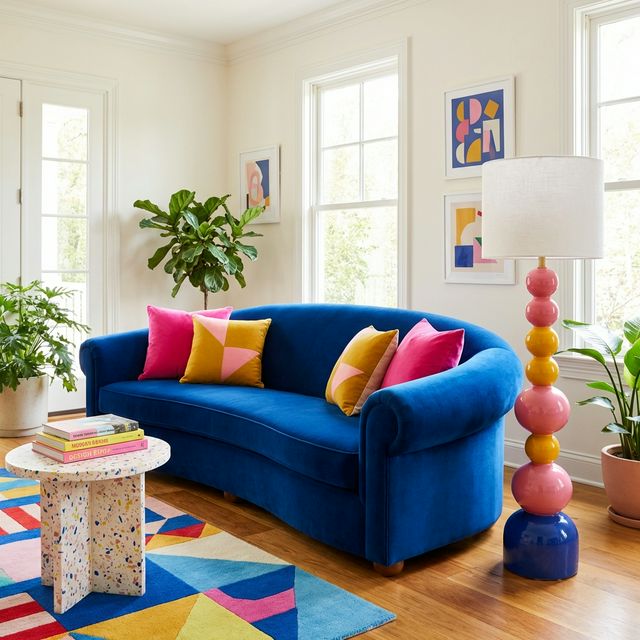
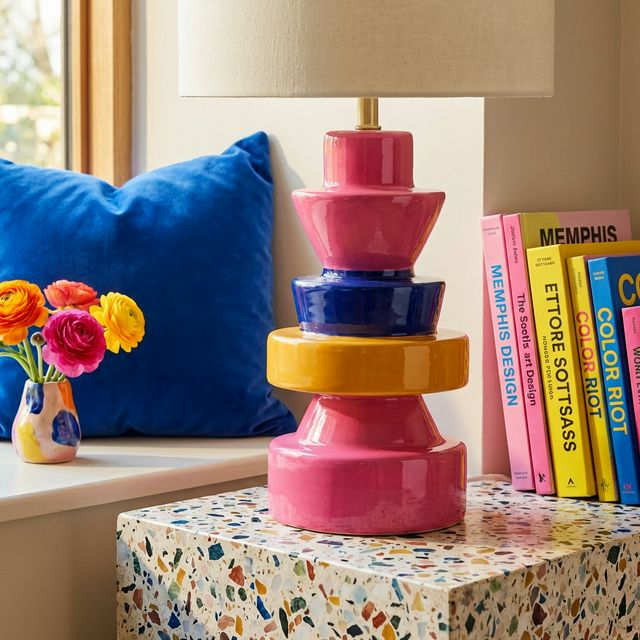
The formula is almost alarmingly simple: take a relatively neutral backdrop — warm white walls, a good hardwood floor — and then introduce one or two pieces that make people stop mid-sentence. A curved velvet sofa in deep cobalt blue with rolled arms that look like they were sculpted, not assembled. A terrazzo side table in confetti-colored chips that somehow manages to be both ridiculous and incredibly chic. A floor lamp with a tiered ceramic base in stacked circles of pink, yellow, and blue — the kind of lamp that makes you wonder if the designer was having fun or having a vision. The answer is both.
The key — and this is where Memphis meets its 2026 evolution — is strategic absurdity. You're not wallpapering every surface in checkerboard. You're placing one magnificent, unapologetically bold piece against a clean backdrop and letting it sing.
It's not chaos. It's jazz.
The Theology of Fun
Here's where I'm going to lose the minimalists and gain the people I actually want at my dinner party.
I think joy is a design choice. And I think it's a spiritual one.
We've spent the last decade designing homes that look like they're meditating. All those whites, all those creams, all that curated emptiness — it was supposed to make us feel calm. And for some people, maybe it did. But for a lot of us, it just made our homes feel like they were holding their breath. Waiting for permission to be alive.
There's a moment in Ecclesiastes — and I promise I'm not about to give you a sermon, but stay with me — where Solomon, a man who literally had everything, writes: "There is nothing better for a person than to eat and drink and find enjoyment in their toil." Not stoic endurance. Not aesthetic discipline. Enjoyment.
God created color before He created people. Think about that. The pinks and cobalts and marigolds existed in sunsets and coral reefs and bird feathers before there was a single human eye to appreciate them. Color wasn't an afterthought. It was the opening act.
So when you put a hot pink lamp on a table next to a cobalt vase and a book with a yellow spine, you're not being frivolous. You're agreeing with the original Designer that the world was meant to be vivid.
How to Start Your Own Rebellion
You don't need to go full Memphis. You don't need to buy a zigzag shelf that costs more than your car payment. Here's where to start:
The Gateway Piece: One sculptural lamp. That's it. Find one with a ceramic or glass base in stacked shapes — circles, cylinders, something that looks like it has opinions. Put it on your most boring surface. Watch what happens.
The Color Anchor: A single throw pillow in an unapologetic color. Not dusty rose — Rebel Pink. Not navy — cobalt. Place it on your most neutral piece of furniture and let it start a conversation with the room.
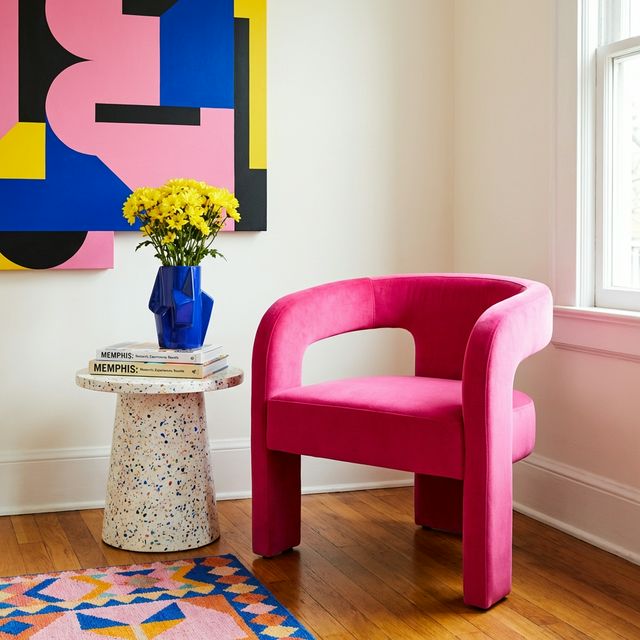
The Statement Seat: If you're ready, the curved velvet sofa is the move of the decade. But even a single accent chair in a bold color with sculptural arms will transform a corner from "fine" to "this person has a pulse."
The point isn't to create a museum. It's to create a room that looks like someone lives here. Someone who laughs. Someone who chose joy over restraint and didn't apologize for it.
Ettore Sottsass designed objects that made people feel things. Not "clean lines" things. Not "visual calm" things. Real things — surprise, delight, the kind of reaction where you walk into a room and your face does something involuntary.
Your home should do that. At least one room. At least one corner. At least one lamp that makes a visitor say, "Wait — where did you get that?"
Because a home that never surprises anyone is just a place you sleep. And you, my friend, were made for more than beige.