

Someone Had the Audacity to Lacquer an Entire Wall in Oxblood Red, and I Have Never Felt More Alive
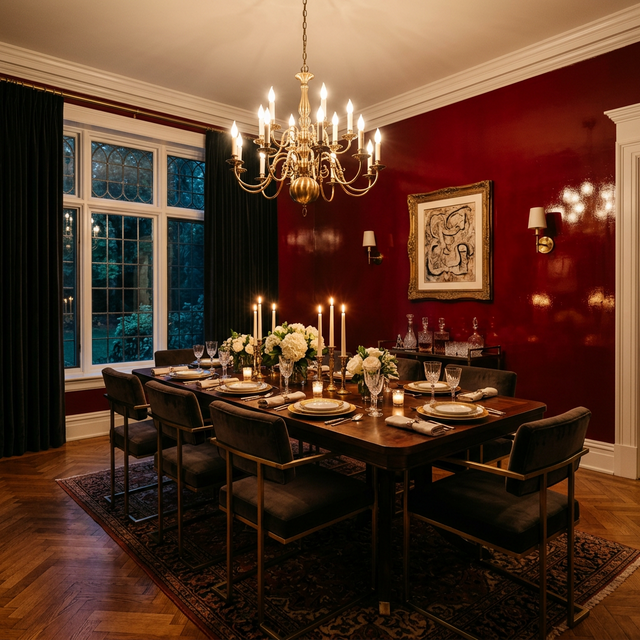
I was scrolling through a designer's portfolio last week — one of those midnight rabbit holes where you start looking for a new lamp and end up rethinking your entire philosophy of surfaces — when I stopped dead on a dining room. The wall behind the table wasn't painted. It wasn't wallpapered. It was lacquered. Twenty-something coats of oxblood red, hand-applied, buffed, and polished until the surface reflected the candlelight like a dark, still lake.
I set my phone down. I picked it back up. I zoomed in on the reflection of the chandelier in the wall itself. And I thought: this is what happens when someone refuses to take shortcuts.
Welcome to the Lacquered Revival, darlings. And I am here for it.
What Exactly Is Happening
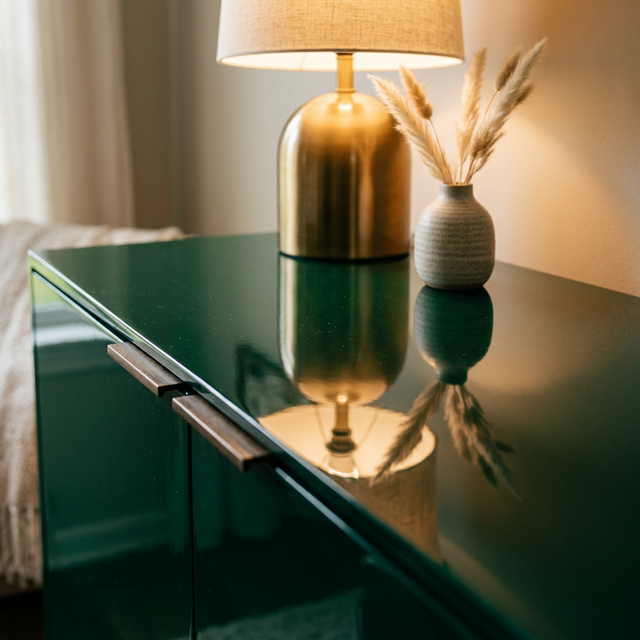
Lacquer — the real kind, not the rattle-can kind — is having a full-throated comeback in interior design. We're seeing high-gloss lacquered credenzas in deep emerald. Console tables finished to a mirror-polish in midnight navy. Kitchen cabinetry with a piano-finish sheen that makes your marble countertop look positively matte by comparison. And yes, entire walls drenched in lacquer so deep you could lose yourself in them.
This isn't new, of course. The Japanese perfected urushi lacquerwork centuries ago — layer upon painstaking layer of tree sap, each one dried in controlled humidity, each one sanded before the next is applied. Chinese lacquer screens. Art Deco cocktail cabinets. The glossy mod credenzas of the 1970s that your grandmother either adored or called "too much." (Your grandmother was wrong, respectfully.)
What is new is the way contemporary designers are deploying it: not as a relic of maximalism, but as a single, deliberate act of courage in an otherwise restrained room. One lacquered piece in a room of linen and plaster. One high-gloss wall surrounded by raw wood and matte ceramics. The contrast is electric.
The Specifics That Matter
Let's talk about what makes lacquer lacquer and not just "shiny paint you bought at Home Depot on a whim."
Traditional urushi lacquer — harvested from the sap of the Toxicodendron vernicifluum tree — requires between 20 and 30 individual coats. Each coat is applied by hand. Each coat must cure in a humidity-controlled environment (75-85% humidity, if you're curious). Each coat is sanded or polished before the next. The process takes months. The result is a depth of color that photography can barely capture — a luminous, almost three-dimensional quality that flat paint will never, ever achieve.
Modern polyester and polyurethane lacquers can approximate the effect with fewer coats, but the principle remains: depth requires repetition, and beauty requires patience.
The colors trending right now read like a jewel box: oxblood red, deep emerald, midnight navy, aubergine, and — for the truly fearless — high-gloss black that turns a wall into a void you can't stop staring into. Pair these with unlacquered brass hardware (which will develop its own patina over time) and you have a room that is simultaneously modern and ancient.
The Pivot: Thirty Coats You Cannot See
Here's what arrests me about lacquer, and why I think it's more than a design trend.
When you look at a lacquered surface, you see one thing: a flawless, reflective finish. But beneath that finish are dozens of individual layers, each one invisible. Remove any single layer and the depth collapses. Skip a step — rush the curing, skip the sanding — and the whole surface clouds, cracks, or peels.
Every coat matters. And not one of them is visible.
If that isn't a metaphor for a life of faith, I don't know what is.
We live in a culture that wants the glossy finish without the process. We want the radiant marriage without the ten thousand small repairs. The unshakeable faith without the seasons of doubt that built it. The beautiful character without the boring, repetitive, invisible work of showing up — day after day, layer after layer — when no one is watching and nothing looks different yet.
But the craftsman knows: this is where the depth comes from.
Hebrews talks about faith as "the substance of things hoped for, the evidence of things not seen." I've always loved that word — substance. Not wishful thinking. Not blind optimism. Substance. The invisible layers that give the visible surface its impossible, luminous depth.
The Spiritual Truth: You Are Being Lacquered
If you're in a season where nothing looks like it's changing — where you're doing the work, showing up, praying the prayers, making the repairs, and the surface still looks exactly the same as yesterday — can I tell you something?
You're curing.
The layer you applied today needs time. It needs the right conditions. It needs to set before the next one can go on. And when someone finally sees the finished product — the marriage, the character, the peace, the home, the you that God is making — they will see a depth they can't explain. A luminosity that flat paint could never produce.
Don't skip the sanding. Don't rush the cure. The depth is in the layers.
How to Start: The Lacquered Life in Three Steps
Entry level: A lacquered tray. Seriously. A high-gloss tray in vermillion or emerald on your coffee table or nightstand. It costs under $80, and it will teach your room what confidence looks like. Try The Lacquer Company — they do hand-poured lacquer in colors that would make a Renaissance painter jealous.
Mid-commitment: A lacquered console table or credenza. Look for vintage pieces from the 1970s (they're having a moment in resale) or commission a local furniture maker to do a piano finish on a simple silhouette. The piece should be the only shiny thing in the room — let it pull focus against a backdrop of matte plaster, raw linen, or limewashed walls.
Full send: Lacquer a wall. Not for the faint of heart or the thin of wallet — professional lacquer application on a wall runs $15-40 per square foot — but the result is transformative. An accent wall behind a dining table, headboard, or reading nook in deep navy or oxblood will make every other wall you've ever painted feel like a first draft.
Whatever you choose: commit to the layers. In your room and in your life. The shortcut always shows.