She Walked Into the Room in a Floor-Length Hem
I need to tell you about the sofa I fell in love with last week.
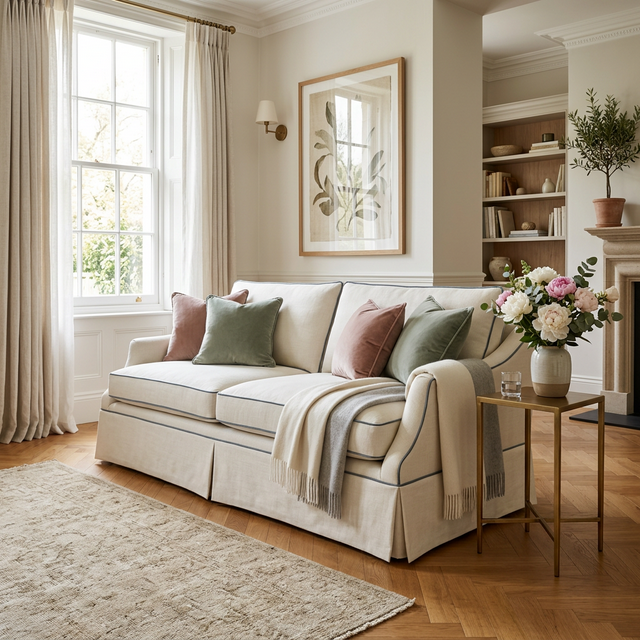
She was sitting in the corner of a showroom in High Point, North Carolina — the furniture market capital of the world, for those of you who haven't made the pilgrimage — and she was wearing a skirt. A proper one. Floor-length ivory linen with a kick pleat at each corner and the most exquisite contrast piping in slate blue I have ever seen on an upholstered piece. She looked like she'd been dressed by a couturier, not assembled in a factory.
I stood there for an embarrassingly long time. A sales associate asked if I needed help. I said, "No, I'm just admiring her hemline." He did not know what to do with that information.
But here's the thing: that sofa wasn't an anomaly. She was the thesis statement of a trend that has been quietly building for eighteen months and is now arriving in full force. Skirted furniture is back. And this time, she brought her whole wardrobe.
What Skirted Furniture Actually Is (And Why It Disappeared)
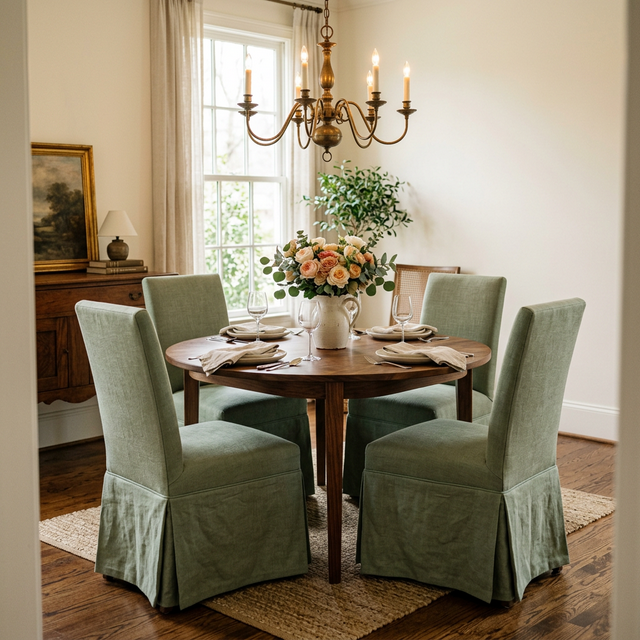
For the uninitiated: skirted furniture refers to upholstered pieces — sofas, armchairs, ottomans, dining chairs — where fabric extends from the seat cushion all the way to the floor, concealing the legs entirely. The skirt can be tailored with box pleats, softened with gathered ruffles, or kept crisp with a straight waterfall hem that barely grazes the hardwood.
This was standard practice in interior design for most of the twentieth century. Think of every stately drawing room in a Nancy Meyers film. Think of your grandmother's living room — the one with the good furniture that nobody was allowed to sit on. Those pieces were skirted. They had presence.
Then the mid-2010s happened. The exposed-leg industrial look took over. Hairpin legs. Brass ferrules. Lucite bases. Everything had to be elevated — literally — off the floor, as if furniture were embarrassed to touch the ground. We wanted to see what was underneath everything. We wanted transparency, airiness, negative space.
And in the process, we stripped our homes of something essential: softness.
The Dressmaker Details
The 2026 version of skirted furniture is not your grandmother's — although, in a delicious twist, Grandma Chic is also trending, so maybe it is. What makes this iteration different is the level of couture-level detail being applied to upholstery.
Elle Decor is calling them "dressmaker details" — the same techniques that a Savile Row tailor or a Parisian atelier would use on a bespoke garment, now applied to a Chesterfield or a bergère. Here's what the best makers are doing:
Contrast piping in unexpected combinations — dove gray linen with piping in burnt sienna leather, or cream bouclé with piping in forest green velvet. The piping becomes the jewelry of the piece.
Kick pleats at each corner, tailored to break exactly at the floor line. This is the detail that separates a $2,000 sofa from an $8,000 sofa, and once you see it, you cannot unsee it. A kick pleat moves. It suggests that the furniture itself might stand up and walk away.
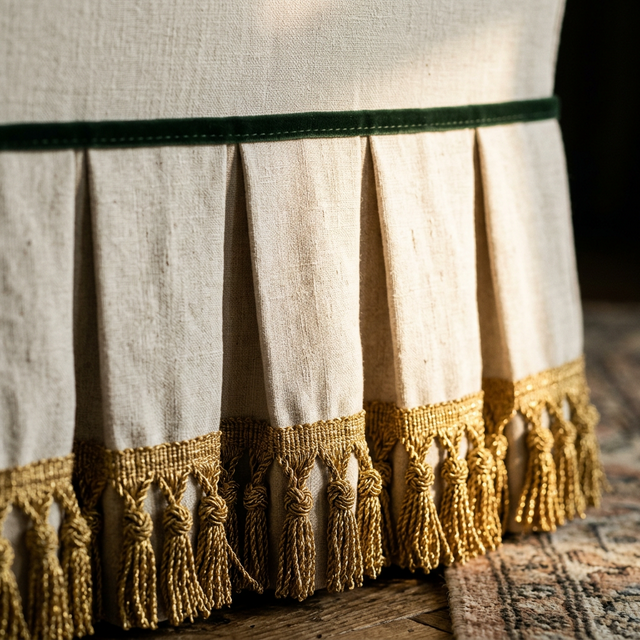
Bullion fringe — that heavy, twisted rope trim — is appearing on the most ambitious pieces. Samuel & Sons, the legendary New York trim house founded in 1996, reports that bullion fringe orders have tripled in the past year. A single yard of their hand-twisted silk bullion runs about $185. It is not for the faint of wallet, but the effect is devastating.
Box pleats in oversized proportions — eight-inch-deep pleats on a sofa skirt that create a rhythmic, architectural quality. When done in a heavyweight Belgian linen — something like Libeco's Heritage line at roughly $95 per yard — the pleats hold their structure like columns.
Who Is Championing This
The skirted revival isn't emerging from one designer or one region — it's converging from multiple directions, which is how you know a trend is real and not manufactured.
Mark D. Sikes, the California designer known for his blue-and-white aesthetic, has been skirting everything for years. He's now being credited as a prophet. His skirted sofas in Brunschwig & Fils cotton prints — often in his signature combination of cobalt stripes and ivory grounds — have become the visual shorthand for the trend.
Lulu & Georgia and McGee & Co. — two of the most influential direct-to-consumer home brands — have both launched skirted sofa collections in the past six months, making the look accessible at the $2,500-$4,000 price point. The fact that the mass-market is following the bespoke market this quickly tells you the demand is real.
And on Pinterest, searches for "skirted sofa" are up 140% year over year, while "skirted dining chair" has spiked 95%. The algorithm doesn't lie.
The Theology of Covering
Here's where I have to be honest with you: the reason I love skirted furniture has almost nothing to do with interior design.
We live in an age of radical exposure. Everything must be visible, transparent, optimized. We photograph the inside of our refrigerators for Instagram. We share our trauma on podcasts. We put glass doors on our kitchen cabinets and track lighting under our beds. We have confused seeing everything with understanding everything.
But some things are more beautiful when they are covered.
There is a Hebrew word — kaphar — that appears throughout the Old Testament. It is most often translated as "atonement," but its literal meaning is "to cover." The mercy seat atop the Ark of the Covenant was called the kapporet — the covering. When God provided skins for Adam and Eve in the garden, He was covering them. Not because their bodies were shameful, but because covering is an act of tenderness.
A skirted sofa understands this. She doesn't expose her bones to prove she has nothing to hide. She drapes. She lets the fabric do the speaking. And that fabric says: I am complete. I am adorned. I do not need you to see my structure to trust that it is sound.
"Above all, love each other deeply, because love covers over a multitude of sins," Peter wrote (1 Peter 4:8). Not erases. Not ignores. Covers — like a hem that falls precisely to the floor, obscuring the rough-hewn frame beneath while honoring the beauty of the whole.
How to Bring the Skirt Home
If you're ready to let your furniture get dressed, here's where to start — at every budget:
The Entry Point ($200-$500): Slipcover an existing piece. A custom floor-length slipcover from Comfort Works or a ready-made option from IKEA's Ektorp line can transform any boxy sofa into a skirted beauty. Choose a heavy cotton or linen-blend in ivory, slate, or sage. The weight of the fabric matters — too light and it looks like a bedsheet; too heavy and it won't drape.
The Investment Piece ($2,000-$5,000): Look at Lulu & Georgia's Mariel Sofa or McGee & Co.'s skirted collection. These pieces come with proper kick pleats, quality foam-and-down cushions, and fabric options that include performance linen (which means your kids can spill on it and you won't weep). Order swatches. Touch them. Hold them against your walls.
The Splurge (Bespoke): If you want the full dressmaker treatment — bullion fringe, contrast piping, hand-sewn box pleats in a heritage fabric — find a local upholsterer. The Custom Furniture & Interiors Association maintains a directory. Expect to invest $5,000-$15,000 for a bespoke skirted sofa, but know that you are commissioning a piece that will outlive your mortgage.
The Quick Win: Start with a skirted dining chair. A simple parsons chair with a straight floor-length skirt in a washable fabric can be found for under $300 from brands like Ballard Designs. Put four around your table and watch the entire room exhale.
Whatever you choose, remember: the hem should just kiss the floor. Not puddle. Not hover. Kiss. That's the detail that separates intention from accident, and in design — as in life — the difference between the two is everything.